
“In modern physics, the field of study is restricted to a physical aspect of experience. This physical aspect is described through mathematical calculations; and the calculations are applied through the development of external technologies, which fabricate instruments and machines for use by our physical bodies. Traditional conceptions are broader and more comprehensive. They describe both physical and mental aspects of experience. Their descriptions are not restricted to mathematical calculation; and their application is not concerned so much with external instruments as with the cultivation and clarification of human faculties. In short, traditional conceptions of the world are less dependent than modern physics upon the achievement of external objectives. They are more directly concerned with the education of our living faculties: through a reflection back to an underlying, subjective ground.”
The Traditional Five Elements
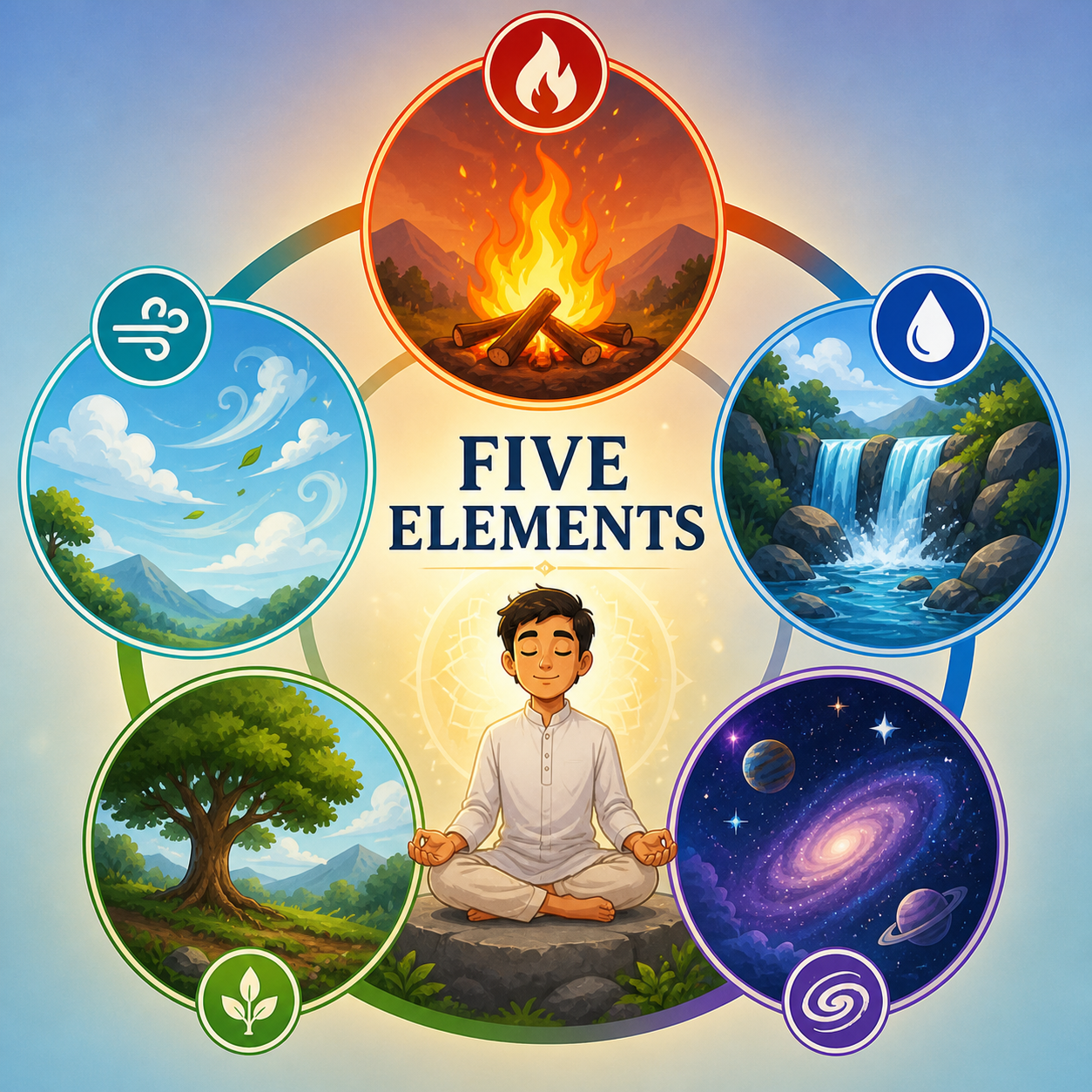
What is the world that nature manifests? This question is answered by the traditional conception of ‘five elements’, shared largely in common by Indian and European traditions.
In the Bṛhadāraṇyaka Upaniṣad, there is an early account of these five elements. A lady called Gārgī points out that the entire world of earthly things is actually made of the element ‘water’, just as a cloth is woven from thread. What then, she asks, about the element ‘water’? If all things of ‘earth’ turn out to be made of ‘water’, then what is ‘water’ made of?
She is questioning Yājñavalkya, who replies that ‘water’ is made of the underlying element ‘fire’. And what about ‘fire’? In its turn, ‘fire’ is reduced to the underlying element ‘air’. Similarly, ‘air’ is reduced to underlying ‘ether’.
Even by a modern academic dating that may have grossly underestimated the age of ancient traditions, the Bṛhadāraṇyaka Upaniṣad is over two and a half thousand years old. It describes the five elements as a conception that was then already established by ancient custom, handed down from the distant past.
For thousands of years, in India and Europe, this conception has been used to progress from the gross particularity of earthly things to the ethereal pervasiveness of space and light throughout the universe. In India, traditionally-minded people still use this conception today.
Like many ancient conceptions, this one is metaphorical. It uses the metaphor of certain physical substances to suggest a subtler and more basic analysis of our experience. But what does the metaphor mean? How might it be interpreted in more abstract, modern terms? Since it is a metaphor that has been used over thousands of years, by many different people, we must expect that it can be interpreted in different ways. In the discussion that follows, one such interpretation is suggested. It is summarized in figure 1.
Through our limited senses and minds, we do not see everything at once. Instead, we see particular objects; and we conceive a material world that is made up of many such objects. Each object is a particular piece of matter, divided from other objects by boundaries in space and time.
| Traditional element | A modern interpretation | Level of modern physics |
|---|---|---|
| ‘Earth’ | Matter | Material objects |
| ‘Water’ | Energy | Changing configurations |
| ‘Fire’ | Information | Relative observations |
| ‘Air’ | Conditioning | Conditioned fields |
| ‘Ether’ | Continuity | Space-time continuum |
This divisible matter corresponds fairly obviously to the traditional element ‘earth’. In a classical Indian metaphor, the particular objects of the world are conceived to be formed from the element ‘earth’ as pots are formed from clay.
At first, the world of particular objects seems solid. But, upon further investigation, it is not so. As objects interact, they are caught in a constant process of formation and transformation. When changing time is taken into account, our solid-seeming world is shown to be only an instant snapshot: a momentary picture taken at a particular instant of time. As time flows, the objects of the world keep changing. Each moment that we look, what we have seen keeps vanishing, transformed into something else.
Through this examination, the seeming solidity of objects gives way to a fluidity of changing forms. It is then clear that matter is not the only element in our experience of the world. In addition to the concrete particularity of matter, we experience a second, more fundamental element – which may be called ‘energy’.
This second element, of energy, is manifested in moving activity; and it thus produces the changing forms of objects in the world. It is associated with the fluidity of change, which makes it correspond to the traditional element called ‘water’.
Through the changing flow of energetic activity, information travels from place to place. This enables us to observe the world. Each observer receives information that represents other things. These represented things are then illuminated by observing them, from a particular point of view.
So, beyond matter and energy, information is a third element of our experience. By representing other things, it throws a particular light on them; and it thus corresponds to the traditional element called ‘fire’.
We do not directly observe the matter and energy in the world outside our bodies and our measuring instruments. External matter and energy are only observed through the representations of information that our instruments have received. In this sense, information is more fundamental than matter and energy.
In its turn, information depends on something further still. In order to represent anything, information depends upon a comparison of represented conditioning. For example, a map shows some places close together and other places further apart. Or it may show how various places are cooler or hotter: by comparative shades of colour, or by numbers that spell out the comparison in a more calculated way.
Thus, beneath the information through which the world appears to us, there is a fourth element: of relative conditioning. It shows the world as conditioned by varying characteristics and qualities, in much the same way that the atmosphere is conditioned by climate. So there is another correspondence here, with the traditional element called ‘air’.
In order to compare the differing characteristics of different places, there has to be an underlying continuity, which extends through space and time. This continuity is understood in a way that is rather different from our perceptions of matter. Where matter is perceived, space and time are distances that separate particular objects and events.
Where continuity is understood, space and time are not just what separates, but rather what connects. Here, distance is not separation, but a connection in between. It is the intervening connection between parts of a world that has been made to seem divided, by our limited and narrow perceptions.
Thus, beneath the differentiated conditioning of the world, there is a fifth element, of pervading continuity. This evidently corresponds to the traditional element called ‘ether’. It is described as the subtlest element, pervading the entire world.
A Comparison with Modern Physics
Reflecting Back to Ground
World and Personality
(This article is an excerpt from Sri Ananda Wood’s book: “Ways to Truth: A View of the Hindu Tradition”. It is available from D.K. Printworld (P) Ltd.)
[Ananda Wood is a disciple of the Sage Sri Atmananda Krishna Menon (1883 – 1959). He was born in 1947. His upbringing and school education took place in Mumbai, India. He obtained his bachelors degree in mathematics and theoretical physics at King’s College, Cambridge, UK and his doctorate in anthropology (with specialization in Indian tradition) at the University of Chicago, USA. After his university education, he returned home to India, where he worked for some years as a junior industrial executive. He has now settled down to work from home in the city of Pune, on a long-standing interest in the modern interpretation of Advaita philosophy.]