Three years ago, Sanya Malhotra starrer movie ‘Mrs.’ was released. Hundreds of facebook and instagram posts have been written and reels have been shared in its criticism. The reader of this article knows the agenda of the movie and if not, please watch the movie with a skeptical lens without any prejudice towards the ideology of feminism. It is entirely acceptable to show any family belonging to any community under artistic freedom but women have been targeted and exploited in every community. Me, as an audience, wants the director to move their camera and script writer to turn their pen towards societies based on theological religions. Well, as every liberal – centralist – secular person says while defending their propaganda — when facts are being thrown at them — every coin has two sides. The director of the movie mentioned above has shown you one side by targeting Hindu families and their institutions, let me show you the other.
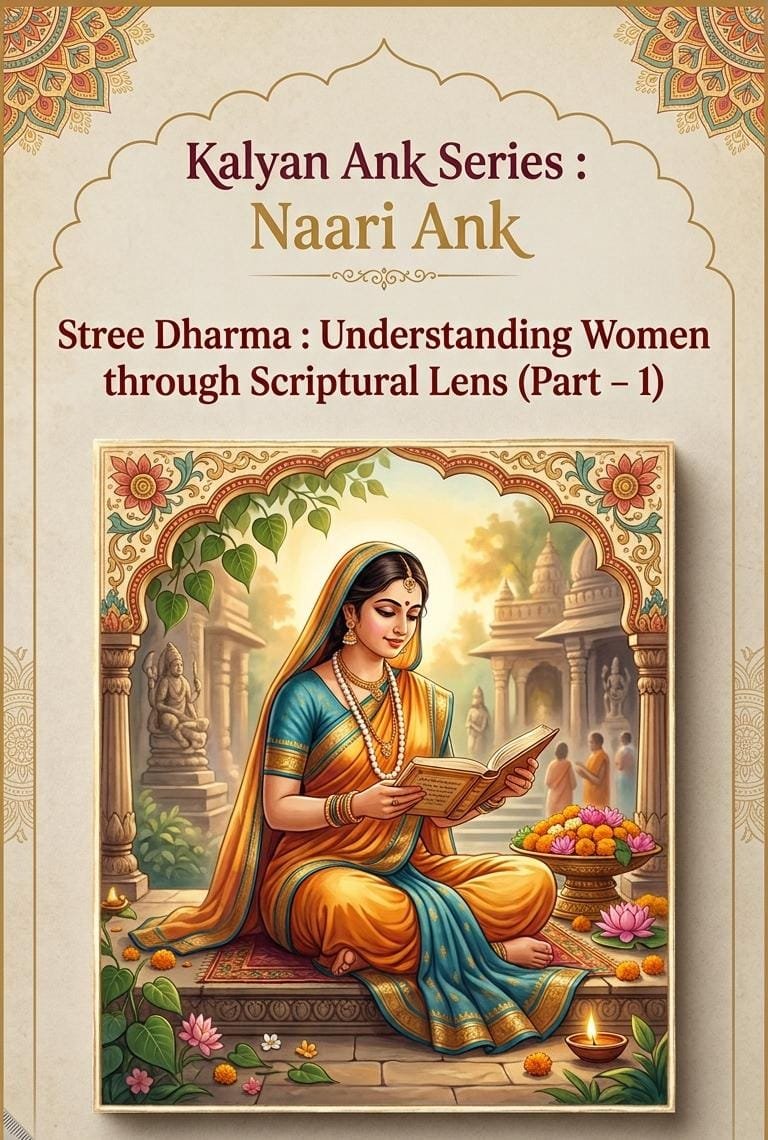
What do Hindu scripture suggest and advice pertaining to the issues of women, let us understand this through the most authentic book, encompasses a bunch of primary sources book – ‘Kalyan’, published by Gita Press, Gorakhpur, is a monthly spiritual and cultural magazine with a distinguished legacy of 100 years. Since its inception in 1926, Kalyan has offered readers insightful teachings rooted in Hindu philosophy, sacred wisdom, and moral values. The consistent quality and trusted content have made it one of the most respected spiritual magzines in the Indian subcontinent. The magazine is serving as a valuable reference resource. It features articles on dharma (duty), vedantic wisdom, stories from the Puranas and Upanishads, lives of saints, and principles of devotion and meditation, providing readers with deep, practical guidance. It is a blend of knowledge and ethics.
Place of women in scriptures : Equal or Superior?
Let us deep dive into what Nari ank of Kalyan offers. In the Nari Ank of Kalyan, it is mentioned that, Ārya-puruṣa has always regarded woman as his ardhāṅginī (better half). Not only this, but in social conduct the dignity of women has always been considered higher than the dignity of man. Hindu-saṃskṛti is filled with this sentiment. The Dharmaśāstra clearly states :
पिता रक्षति कौमारे भर्ता रक्षति यौवने ।
रक्षन्ति स्थविरे पुत्रा न स्त्री स्वातन्त्र्यमर्हति ॥
pitā rakṣati kaumāre bhartā rakṣati yauvane |
rakṣanti sthavire putrā na strī svātantryam arhati ||
The father protects her in childhood, the husband protects her in youth, and the sons protect her in old age. Thus a woman is not meant to live without protection.
This must be properly understood. According to the Dharmaśāstra, this is not the harmful deprivation of a woman’s freedom. Rather, a woman can practice her svadharma without obstruction, the responsibility of protecting her from external dangers has been placed upon society, especially men. A man who reveres dharma does not see this as a burden; he accepts it as a sacred duty and performs it as a righteous obligation. The Kalyan Ank puts that the devout Indian woman who has faith in these divine words does not experience this arrangement of the Dharmaśāstra as a deprivation of her freedom or as an obstacle to her progress. Rather, living within this moral framework, she firmly practices the satītva-dharma which brings glory in this world and the next, thereby becoming an ideal of nāri-dharma in practical life and attaining the highest good spiritually.
Devotion towards husband : A service or relaxation in spiritual duties
The Kalyan Ank further describes the duties of women in the eyes of Dharmaśāstra :
नास्ति स्त्रीणां पृथग्यज्ञो न व्रतं नाप्युपोषितम् ।
पतिं शुश्रूषते येन तेन स्वर्गे महीयते ॥ (मनुस्मृति 5,158)
nāsti strīṇāṃ pṛthag yajño na vrataṃ nāpy upoṣitam |
patiṃ śuśrūṣate yena tena svargge mahīyate ||
Meaning : Women need not perform separate sacrifices, vows, or fasts. By devotedly serving the husband, they attain honor in heaven.
This suggestive deed of the Dharmaśāstra is extremely meaningful and profound. It contains the secret of the principal duty of a woman—pātivratya. The intention is certainly not that a woman should remain a servant of man. Rather, the system of pātivratya-dharma is meant to establish a woman’s life on the path of threefold progress— ādhibhautika, ādhidaivika, and ādhyātmika.
- Adhibhautika literally means pertaining to the bhuta or living beings.
- Adhidaivika literally means pertaining to the daiva or fate, unseen forces and gods.
- Ādhyātmika literally means pertaining to the ātma or the body (and the mind).
A pativratā woman, this ank propounded, naturally spends most of her time serving and caring for her husband. Consequently, her inner feelings become centered upon him. According to the teaching of the Bhagavad-Gītā :
यं यं वापि स्मरन्भावं त्यजत्यन्ते कलेवरम्।
तं तमेवैति कौन्तेय सदा तद्भावभावितः।।8.6।।
yaṃ yaṃ vāpi smaran bhāvaṃ tyajaty ante kalevaram |
taṃ tam evaiti kaunteya sadā tad-bhāva-bhāvitaḥ ||
Meaning : Whoever at the end leaves the body, thinking of any being, to that being only does he go, O son of Kunti (Arjuna), due to his constant thought of that being.
Therefore, nari ank puts, women do not require separate yajña, vrata, or upavāsa for their spiritual upliftment; by devotion to the husband they can attain a noble destiny. The imperishable glory of pātivratya described in the śāstras is not merely ornamental praise—it is literally true. Through pātivratya, the sattva-guṇa within a woman’s heart can increase so greatly that spiritual knowledge (jñāna) may arise in her. Examples such as Maitreyī illustrate this.
As Gita says :
सत्त्वात् संजायते ज्ञानं रजसो लोभ एव च |
प्रमादमोहौ तमसो भवतोऽज्ञानमेव च ||
Meaning : Only from an abundance of Sattva knowledge— including Self-realization—properly arise. Only from a predominance of Rajas does the desire for heaven and other such enjoyments emerge. And only from a predominance of Tamas, owing to negligence, does engagement in wrongful actions occur, resulting in perverse understanding and ignorance.
The female birth involves many sufferings, especially during childbirth. Therefore the Dharmaśāstra established pātivratya-dharma as a path to liberate the soul from repeated suffering.Through proper observance of pātivratya, divine powers may naturally manifest within a woman. This is its ādhidaivika benefit. Powers that men acquire through difficult yoga and tapas can arise naturally in women through this vow. This is how our culture has been polite and generous towards women.
Now, a certain section of the society (to be honest, a vast section of the society) in utter ignorance emphasizes and repeatedly questions the norm of obeying the laws of the Dharmshastras. In this matter, two things must be clear to every sanatani:
- Dharmaśāstras are not compulsory (read asmani) books to follow; as Rajiv Malhotra puts in his book – Varna, Jati and Caste, these are advisory guides to regulate one’s own life in case of any perplexing situation.
- The rules of the Dharmaśāstra concern the welfare of the soul across many births. They assist the natural progress of the jīva. The truth of dharma is subtle and difficult to grasp, as Mahabharat mentions; धर्मस्य तत्त्वं निहितं गुहायां (dharmasya tattvaṃ nihitaṃ guhāyām) – the mystery of dharma cannot easily be understood by ordinary intellect. Therefore scriptures emphasize practice rather than constant questioning. It is better for ordinary people to follow the rules of dharma with faith and devotion rather than become confused by endless speculation.The more a person shapes life according to Dharmaśāstra, the more he advances in the spiritual evolution of the jīva.
This ank definitely encompasses other issues too, they’ll be covered in the next part.