The academic fault perpetuated by every new and ‘senior’ woke and modern fellow, is to keep all the civilisational backwardness and ill practices in the same frame without realising the fact that ill practices of Sanatana Dharma are erupted during the medieval period and a through a pace of time and are not verified or sanctioned by the scriptures, but on the other hand, the backwardness or orthodoxy or the so– called ‘male chauvinism’ and ‘misogynistic’ approaches of theological religions are sanctioned by their the scriptures. For instance:
- “Men have pre-eminence above women” (Quran 4.34).
- “A woman is a man’s tilth unto whom he may go as he desires” (Quran 2.223).
Roles of Women
The Naari Ank of Kalyan highlights other roles of women emphasizing the vitality and special place of women. As it is mentioned in the ank, the Brahmavaivarta Purāṇa states:
stanadātrī garbhadhātrī madhyadātrī gurupriyā |
abhīṣṭa-deva-patnī ca pituḥ patnī ca kanyakā ||
sagarbhajā yā bhaginī putra-patnī priyāprasūḥ |
mātur mātā pitur mātā sodarasya priyā tathā ||
mātuḥ pituś ca bhaginī mātulānī tathaiva ca |
janānāṃ vedavihitā mātaraḥ ṣoḍaśa smṛtāḥ ||
[These sixteen types of mothers are described in the Vedas: the woman who breastfeeds, the one who gives birth, the one who feeds, the wife of the teacher, the wife of the chosen deity’s priest, the step-mother, the father’s daughter, the sister, the son’s wife, the mother-in-law, grandmother, aunt, and others.]Similarly, according to Manu, the status of the mother is many times higher than that of the teacher, the instructor, or even the father. From pregnancy until the child goes to the gurukula, the mother nurtures and protects him. This demonstrates that the essence of womanhood is matritva (motherhood), which is considered a blessing of the Jagadambā. The Vedic teaching “matridevo bhava” instructs reverence toward the mother. This expands into reverence for all women. But sadly, the entire revolution and fight of feminists heavily rely on the equality of men and women by simultaneously bashing Manu for considering women higher than men. Poor Feminists!
As the famous Devyaapradhkshmapanstotram by Adi Shankaracharya has this line: “kuputro jāyet kvacid api kumātā na bhavati” (Wicked may be the son, but never the mother). Other Puranas, as given in the ank, as well state the eminence of women’s place in sanātana psyche. Women who have protected the nation and lived lives of sacrifice, austerity, devotion, and service are regarded as special manifestations of the Jagadmātā (mother of the world). Yājñavalkya states that women should be honored by husbands, brothers, fathers, relatives, in-laws, and family members. According to the Viṣṇu Purāṇa:
devatiryaṅ-manuṣyeṣu puṃnāmā bhagavān hariḥ |
śrīr nārī śrīś ca vijñeyā ||
[Among gods, animals, and humans, the male principle represents Hari, and the female principle represents Lakṣmī.]
Gender equality in scriptures
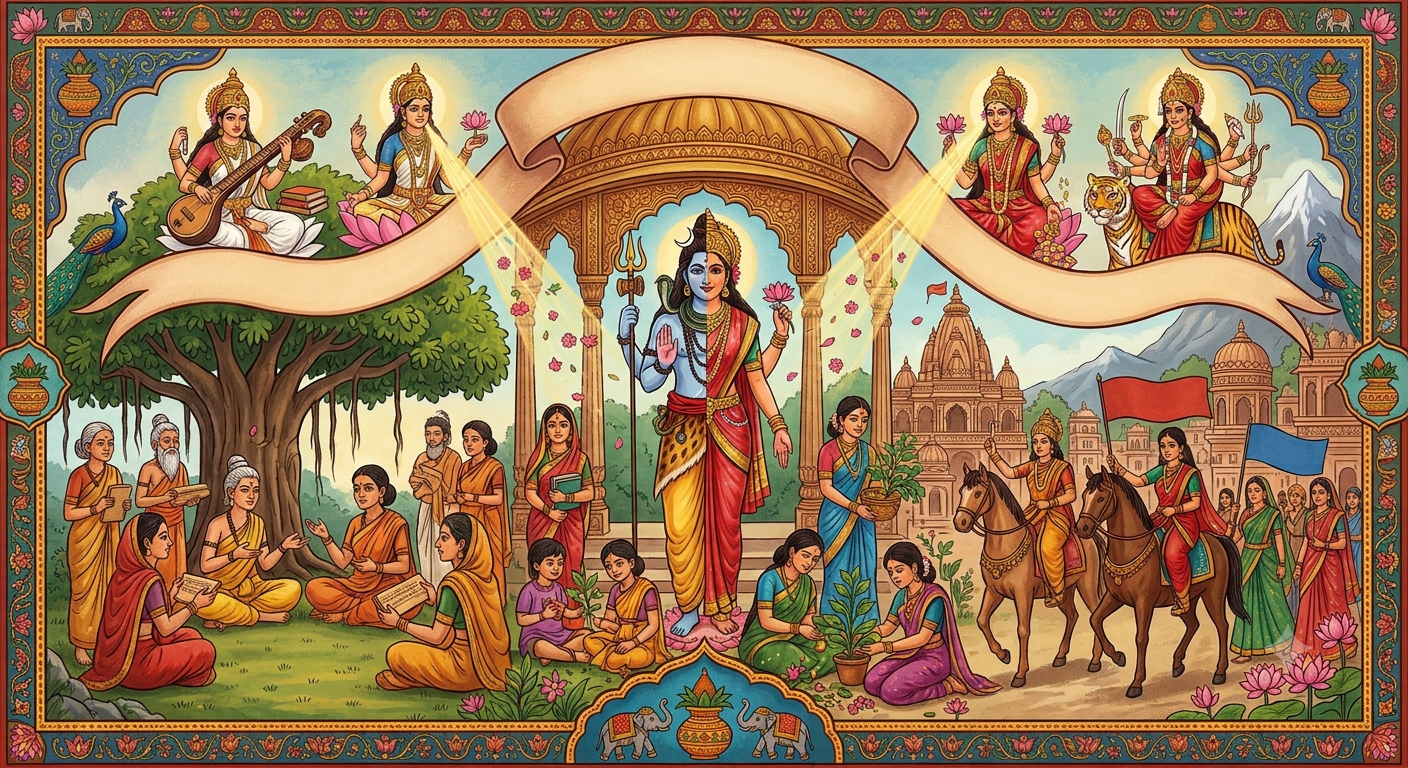
The ank further adds, how the scriptures have rules and ideas for men and women equally, it explains that srushti is created half male and half female, establishing unity in marital life. The husband should be devoted to his wife and the wife to her husband. An ideal pativrata woman considers only her husband as man: “patimatram purusham manyamana”. Similarly, a righteous husband treats other women as mothers, as illustrated in the example of Rama.
Furthermore, this ank prominently highlights that darshana-shastras, which explains the inner world, have six major philosophical systems: Nyaya, Vaisheshika, Yoga, Sankhya, Purva Mimamsa, and Uttara Mimamsa. In these philosophies the relationship of purusha and prakriti is discussed in various ways. All these systems ultimately acknowledge the importance of prakṛti in creation. Whether called mula-prakriti, mahamaya, or brahma-shakti, the principle remains the same. Therefore, honouring women is seen as a natural extension of reverence for prakriti. The scriptures even declare: Where women are worshipped, the devatas rejoice; where they are not honored, all religious actions become fruitless. Families in which women suffer decline quickly, while those where women are happy prosper continuously.
Naari Ank adds that the Vedic view recognizes two streams of creation: the prakriti-dhara and the purusha-dhara. Since women are closely connected with prakriti, it is not incorrect to say that woman herself embodies prakriti. Texts like the Devi-Bhagavata and Durga Saptashati declare that all knowledge and all women are manifestations of the Devi. In the Sanātana tradition, therefore, reverence for women is prescribed. Society expects women to remain pure and faithful so that the ideal of satitva (chastity) continues. However, the responsibility of dharma belongs equally to men. A husband should never think of his wife as inferior. He must care for her, serve her during illness, and treat her with affection and respect. Only when a man himself lives by dharma, speaks kindly, remains devoted to his own wife, and behaves like a true friend can win her heart. And that is how Nari ank of Kalyan elucidates about gender equality, role of women, place of women and devotion towards husband through the lens of scriptures with the references of shlokas and suktas.