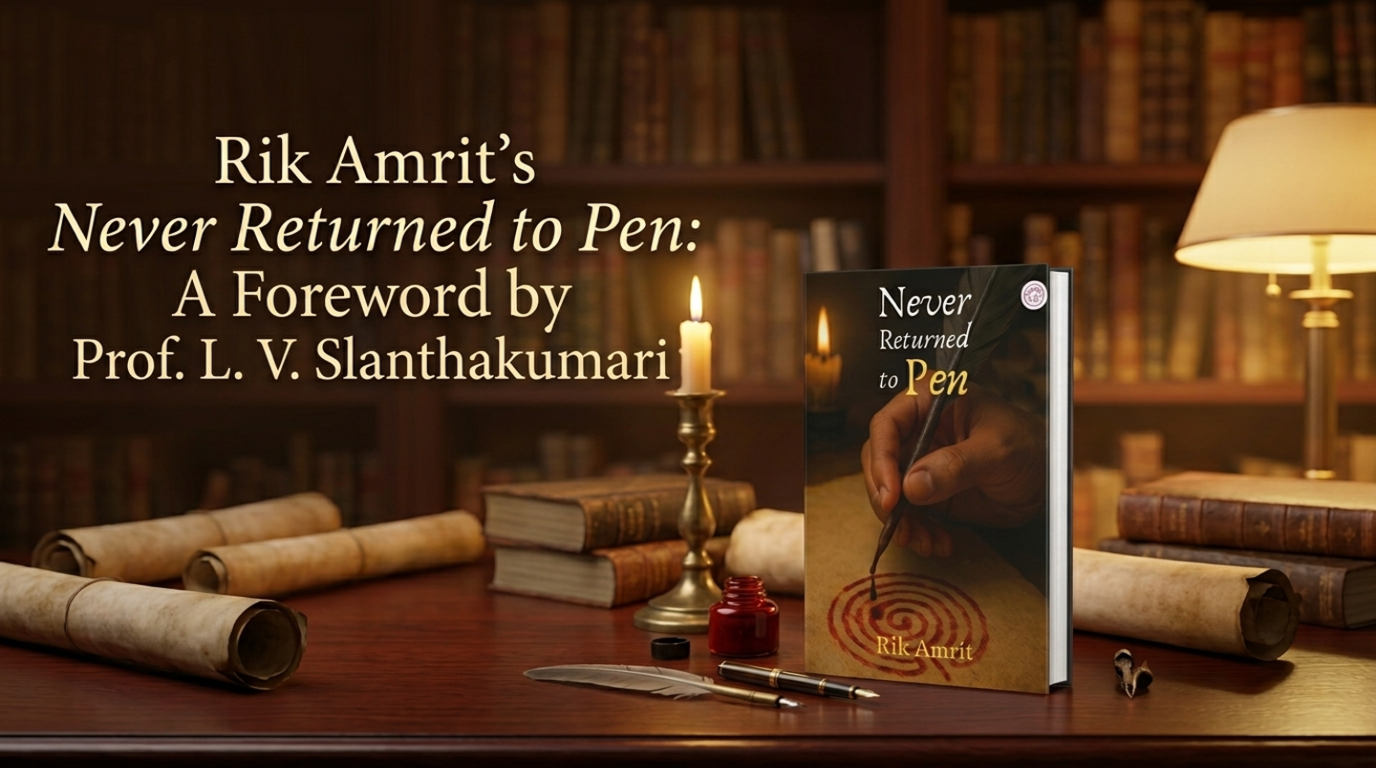
Rik Amrit, a young, promising poet, has translated his poems from Bengali—his mother tongue—into English, with the intention of “reaching the readers”, for he sincerely believes that literature should befriend readers rather than alienate them, especially in our “fractured age”. He has “mined” his three earlier collections, chosen the poems, and translated them into English. This process of translating poems composed earlier has helped him converse with his younger days. As such, here is a fusion of the feelings and emotions of younger days and the experience of present maturity. Rik puts the question before the beginning of his poems; the answer is also provided by him.
“What makes you Amrit, Rik?
Churning of self, of silence, of the unseen.”
The Vedic Philosophy in His Poetry
Rik, Tom, Jack, or John are only simple names. But Amrit as a name also brims with meaning. Amrit may be nectar; Amrit may mean immortal or eternal. To enjoy the Amrit of life, to become eternal or immortal, Rik or a common being has to churn his own self, churn the silence and the unseen. This grants to Rik or any common being the knowledge of eternity—Amritatva. The title Never Returned to Pen is also pregnant with a special meaning. Ink that comes out of the pen and becomes letters, words, and writing cannot again return into the pen and become ink.
Pen is an implement for writing, and the above explanation suits the title. Pen also means a small enclosure, a confined space. Any individual who once comes out of such a confined environment cannot again return to the same confined place, for life, mind, and intellect go on expanding from a point to circles, and an expanded circle cannot again become a small point. Rik has divided the collection into three chapters: Displacement, Awakening, and Reckoning. There is an Epilogue with only one poem, ‘Bereft’.
The Consciousness of the Self
In the Chapter One: Displacement, the first poem, ‘Archaeological’, picturises the feelings of the poet, who, it seems, is separated from the city he loved. The title suggests a sort of excavation—here not of physical remains, but of the remains of past experiences in the mind (psyche). The whole topography of the city, once lived in and loved by the poet, unwinds before us, and how the endured memory is “kept below his pillow”—as a haunting memory. He feels below his pillow “tramlines, burning electric crematoriums”, and “people who come to fall asleep or to wake up”.
“Everyone seems to the poet somewhat familiar, as if they have fallen from the same branch.” This line establishes that all of them are of the same origin, belonging to the same branch—“fallen from the same branch”—perhaps from the same tree of life.
The poet goes on explaining how he feels the busy life of the city in his memory underneath the pillow; he wishes to feel the hustle and bustle of that city and “rewinds the flow playfully”. Slowly, after the mystical chanting, darkness envelopes. Thus, the poet brings the memory of the city into womb life, that is, into the interior of his being. This cannot be materialised, as it belongs to the past. “Below my pillow” symbolises what is under the head and the memory inside the head. Such memories have to be suppressed under the pillow and lived and relived only in memory. As such, the poet wipes his tears with a kerchief that has become old from wiping those tears. Thus, the poem becomes an archaeological excavation, digging into past memories and their result.
The Symbolism
‘Never Returned to Pen’, after which the very book is titled, is a poem that states that words etched on paper never return to the embrace of the pen, that is, the implement for writing. Pen has another meaning also—that is, a small enclosure or a confined place. Incidentally, Never Returned to Pen is also the title of the poem collection. The poem tries to say that the words etched out on the paper with a pen never return to the embrace of the pen. In the same manner, words that come out of our being—mind and heart—cannot go in again and lose their effect and existence. In the same way, men or women who once leave their place of origin may not return to their once loved places.
The poet uses the myth of Krishna, who left for Mathura from his dear Gokula and did not return to Gokula. The poet gives another example—rather a relevant and universal one—to clarify his idea: people of any age may perish, but the language they used and the culture they nurtured will remain.
At another level, the title of the poem seems to say that an individual who leaves the pen-like enclosure never wants to return to that small pen that hinders his mental, physical, and spiritual growth. Yet the last stanza reveals that finally “An unquenched pyre awaits / Chandidasa as remains, subtly touching the bodies”. That is the final pen to which each has to return. In such poems, the poet gives vent to his philosophical thoughts that are stirring his mind. ‘Dag Acche Hai’ seems to be the next part of ‘Never Returned to Pen’, but with greater intensity.
“The pen bleeds blue onto your shirt pocket
Right where your heart pounds;”
When the pen bleeds—leaks—there will only be a dag. A stain—that will be your own mark. This stain of the pen is coagulated (the word commonly used when bleeding changes from liquid form into a semi-solid state—clotting, etc.). Here, the pen bleeds blue ink, and the dag is the blue stain of the ink from the pen. This mark or stain of the pen may also be the word of the poet—coming out of his mind and heart. And then this dag seems to be “Acche Hai”. As time passes, by afternoon, the blue deepens to black. “The irony of this ‘Dag Acche Hai’ is ‘Advertising, selling us our own wounds / As virtue’.”
“The pen has always
Been the heart’s needle.”
Such lines are pregnant with meaning. The end of the poem says, “The ink knows what you don’t—it was always blood”, but it is learning to be blue for a more civilised world.
Blood symbolises life, warmth, cruelty, passion, bloodshed, friendship, and such diverse emotions, and words carry both positive and negative meanings. But the art of composing a poem and making it say “Dag Acche Hai” needs the power of an elevated mind that realises what the ink knows. Ink here is elevated to the qualities of art that knows how to ameliorate harsh, rough, and cruel emotions, and preserve its blue for a more civilised world.
‘An Advertisement’ depicts “What happens when your desperate scream / Breaks through years of careful silence”. The poet says that this desperate scream gives birth to a deeper silence, and the world calls it art. The poem picturises the feelings of the audience or reader and their praise. This is the alchemy of voice into void. The poem picturises the reaction of the world and the reaction of the poet to fame. In the end, there is a satirical tone about advertising oneself in today’s world of self-propagation.
“You have learned to sell.”
The ‘Reckoning’ contains ‘Disconnect’ and other poems and prose compositions. ‘Disconnect’ reveals the poet’s melancholic thoughts and the quest for the roots that have brought us here in the night’s murmur, amid darkness. There is a longing to turn upwards and reach the star that casts light upon the earth. There is a saying: “Hitch your wagon to the Pole Star”. The desire to have that which is most valuable and sublime stirs a man to endeavour hard to attain it. ‘Rebirth’ is a short poem with serious philosophical brooding. The poet here contemplates rebirth and makes a profound statement:
“From within the Rik
Emerging a new Rik out
Yet is not merely obscene.”
When clothes fall off the body, there is a sense of helplessness, which must be acknowledged—whether in any day-to-day helpless situation or when the body, the clothes of being, falls off.
Conclusion
I wish wholeheartedly that Rik Amrit may continue to progress in the poetic rendering of his thoughts and feelings, mirroring his ideas and experiences in the modern world. I am happy to write a few words on his poems. For this, I thank him and Sri Arjun Bharadwaj, who introduced his poems and requested me to write these words.
About the Book
Book Title: Never Returned to Pen
ISBN Number : 978-81-975504-7-8
Author : Rik Amrit
Published By: Dhvani Publication