

I still remember a moment from my first year in the doctoral programme in Area Studies at Kyoto University that left a lasting impression. One of our Japanese professors introduced a notably simple yet profound research maxim: 動くものは数え、動かないものは計る—“count what moves; measure what does not.” At the time, I was still finding my footing in this interdisciplinary field, but that phrase resonated deeply. It captured something essential about the Japanese approach to fieldwork and research, especially among scholars working in Southeast Asia and Africa. I was struck by their quiet dedication to collecting data—statistics, artifacts, oral histories—and their meticulous efforts to catalogue and preserve these things. It was my first real encounter with the ethos of ‘data-driven inquiry’ that underpins much of Area Studies, a discipline shaped by the geopolitical currents of the Cold War yet constantly evolving. Reading Senoh Kappa’s Japanese book brought me back to that classroom moment. The book exemplifies the same spirit of grounded observation and empirical curiosity, and it was this resonance that compelled me to engage with it more in this brief review.
Introduction
Nearly forty years after its first publication, 河童が覗いたインド (Kappa Ga Nozoita Indo), translated as “Kappa’s Glimpses of India”, by Senoh Kappa remains a outstanding achievement in Japanese travel literature. This book uniquely combines the meticulous eye of a stage designer with the curiosity of an ethnographer. First published in April 1985 by Shinchosha and subsequently reissued in a compact Bunko edition in 1991, this 304 –page Japanese travelogue is renowned for its plentiful hand-drawn illustrations, each of which is paired with precise measurements and handwritten notes.

Figure 1. Cover Page – Kappa’s Glimpses of India. (Note: The image is solely intended for reference purposes.)
This book constitutes a part of the series, which includes other titles such as “Kappa’s Glimpses of Europe” and “Kappa’s Glimpses of Japan”. The series deviates from the conventional model of guidebooks or travelogues. Instead, it constitutes a creative exploration of renowned places and mundane life, blending the author’s artistic sensibility and curiosity. Despite suffering from diarrhea and heatstroke, the author travels various cities equipped with a sketchbook and measuring tape, presenting a vivid portrayal of India to the reader. This brief review explores the book’s unique combination of visual and textual storytelling, its enduring relevance, and the distinctive nature.
Arrangement of the book
The book’s structure is loosely sequential, following authors travels across India in the late 1970s and again in the early 1980s. The chapters are organised by places, namely Kolkata, Sacred River-Varanasi, Khajuraho, Agra, Delhi, Mumbai, Hyderabad, Chennai, Madurai, Cochin, Mysore, Bangalore, Ajanta, Ellora, Udaipur, Jaipur, Srinagar, and more. This allows readers to access the story at any point, enabling a flexible reading experience.
Hand-drawn illustrations and meticulous measurements
The most immediately apparent aspect of this informative book is its visual style. Each page has been embellished with meticulous hand-drawn sketches by Senoh, along with handwritten annotations and precise measurements. The illustrations are not merely decorative elements; rather, they are indispensable components of the book’s research endeavour, serving as both a record of the fieldwork and a means of interpreting the collected data.

Figure 2. Gopuram of Sri Varadharaja Perumal Temple Kanchipuram. (Author’s annotation; “one of the Seven sacred cities of India”. “The marking of Shri Vishnu is visible”). Note: The image is solely intended for reference purposes.
Senoh’s drawings range from bird’s-eye views of hotel rooms (complete with furniture placement, window dimensions, and even the temperature of the room) to cross-sections of train compartments, street scenes, architectural details, and everyday objects like post boxes, lunch boxes, currency notes, etc.
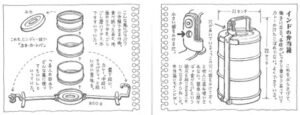
Figure 3. Indian Tiffin Box. (Author’s annotation; “Each container fits perfectly together, so the curry does not spill. It is well made”.) Note: The image is solely intended for reference purposes.

Figure 4. Reserved Seat Compartment. (Bengaluru-Ernakulum Express Train). Note: The image is solely intended for reference purposes.
He often includes annotations about materials, colours, and textures, as well as observations about how spaces are used and inhabited. The result is a kind of visual fieldwork, where the act of drawing becomes a way of seeing, understanding, and communicating the complexities of Indian life.
This approach aligns with recent trends in visual anthropology and multimodal ethnography, which recognise the value of drawing and sketching as tools for observation, analysis, and representation. Unlike photographs, hand-drawn sketches invite readers to slow down, to notice details that might otherwise be overlooked, and to engage with the materiality and atmosphere of the places depicted.
Throughout the book, Senoh uses his sketches not only to record what he sees but also to reflect on his own position as an outsider, a Japanese traveller in India. He is acutely aware of the limitations and possibilities of his perspective, and he often comments on the challenges of understanding a culture so different from his own. Rather than positioning himself as an expert or authority on India, he presents himself as a perpetual learner —someone who is constantly surprised, delighted, and sometimes confounded by what he encounters.
“Firstly, it is a country that embraces nature in all its forms, and it has a vast territory. It is also extremely diverse in terms of its people and climate”.
His tone is conversational and accessible, often punctuated by anecdotes, self-deprecating humour, and moments of wonder. He is quick to admit his own mistakes and misunderstandings, and he frequently reflects on the challenges of navigating unfamiliar customs, languages, and social norms.
He often comments on the contrasts between Japanese and Indian approaches to cleanliness, order, hospitality, and public space. At the same time, he is sensitive to the dangers of ethnocentrism and is careful to avoid simplistic judgments or stereotypes. Instead, author seeks to understand the logic and values underlying the practices he observes during his travels.
A hallmark of Kappa’s Glimpses of India is its attention to ethnographic details. Senoh’s sketches and notes are filled with precise measurements—room dimensions, furniture sizes, distances between objects, and more.

Figure 3. A top-view of a hotel room at the Park Hotel, Kolkata city.

Figure 4. Post boxes in India (Note: The images are solely intended for reference purposes.)
This practice, rooted in his background as a stage designer, reflects a deep interest in how space is organised and experienced. For example, when staying in a hotel, Senoh meticulously measures the width of the bed, the height of the ceiling, the placement of windows and doors, and even the temperature of the room. He records the patterns on bedspreads, the arrangement of toiletries, and the design of light switches. In public spaces, he sketches the layout of train compartments, the flow of traffic in city streets, and the architecture of temples, and other edifices.
Japanese perspectives on India have historically been shaped by a mix of fascination, reverence, and ambivalence. India is perceived by many Japanese people as the origin of the Buddhist teachings, and as a nation where a multitude of pluralistic thoughts and ideas have emerged. Simultaneously, for a considerable number of visitors, India is perceived as a country characterised by constant noise and chaos. Senoh’s book both engages with and complicates these tropes, offering a more nuanced and embodied account of Indian life. In a chapter titled as ‘Sacred River’, Senoh writes:
“Immersing oneself in the Ganga River is nothing short of a divine occurrence, yet there is a specific place that is highly favoured. This sacred place is Varanasi, pronounced ‘Benares’ in the local dialect. I wanted to visit to see people bathing in the sacred river”.
Contextual Background: India in the 1980s
Senoh’s travels in India took place during a period of significant change and complexity. The 1980s were a time of political disturbances, economic transformations, and social changes in India. The decade saw the return of Indira Gandhi to power, the rise of new political parties, the assassination of Indira Gandhi and the subsequent leadership of Rajiv Gandhi, and a series of events that would shape the country’s trajectory for decades to come.
Senoh’s observations capture the complexities and contradictions of this period. While discussing the diversity of Indian languages, Senoh mentions about the 1961 Census and contended matter of identification of numerous “mother-tongues”. This shows Senoh’s awareness and understanding of India. In his book, Senoh made an attempt to document the diversity of Indian society—its languages, religions, customs, and cuisines—as well as the challenges of poverty and inequality.
Concluding remarks
Kappa’s Glimpses of India is more than a travelogue; it is a work of art, a visual ethnography, and a meditation on the possibilities and limits of cross-cultural understanding. Senoh Kappa’s fusion of drawing, measurement, and narrative creates a portrait of India that is at once intimate and expansive, personal and universal. His humility, curiosity, and empathy invite readers to join him in the practice of attentive observation, to appreciate the richness of everyday life, and to reflect on the complexities of cultural encounter. Four decades after its publication, the book remains as fresh and relevant as ever—a testament to the enduring power of curiosity, the value of embodied observation, and the possibilities of visual storytelling.
Notes:
- All the excerpts and images from the book titled 河童が覗いたインド (Kappa Ga Nozoita Indo) are intended for reference purposes only.
- The Japanese to English translation has been carried out exclusively for the present review article.

