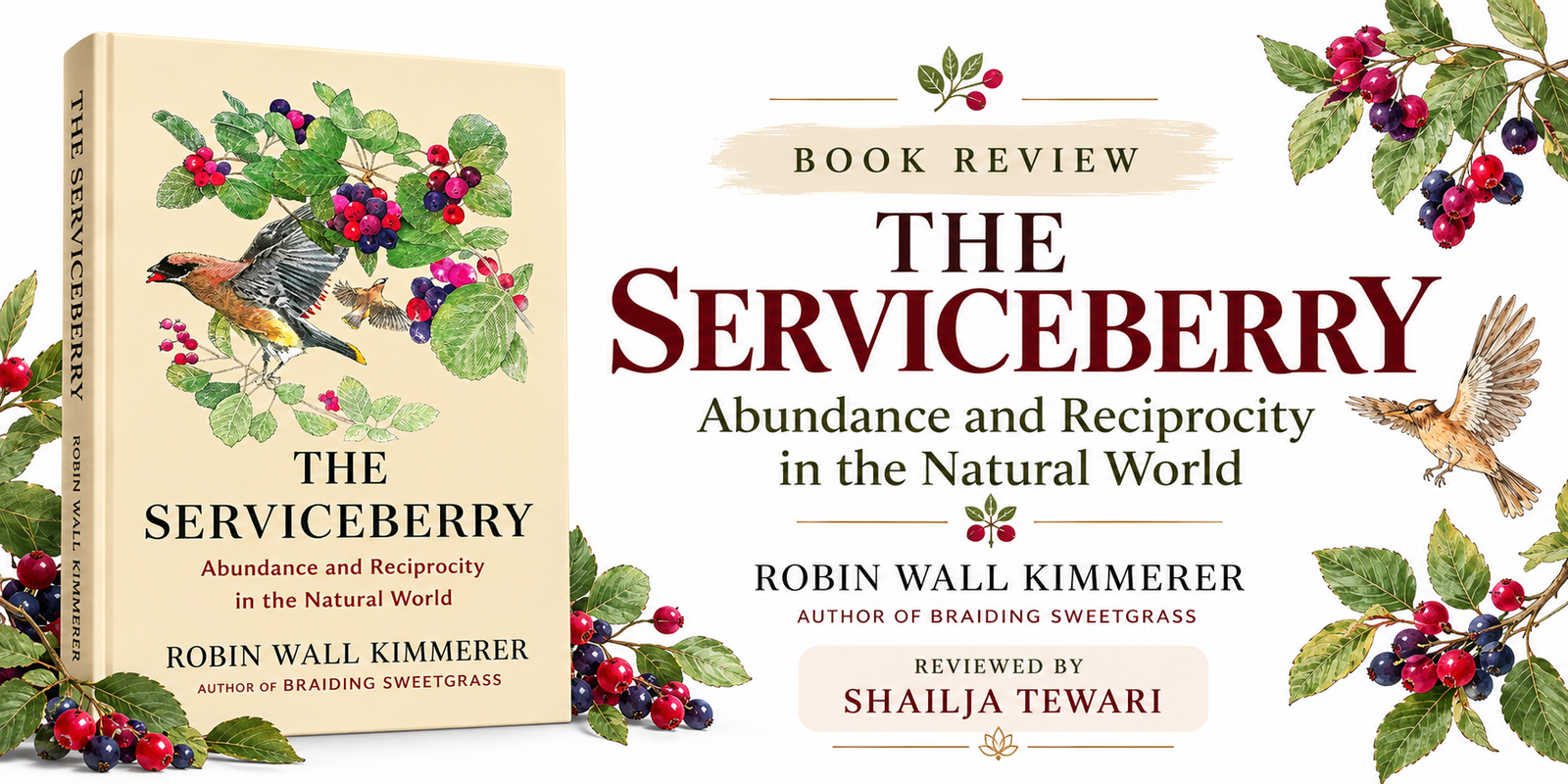
Book Review-
The Serviceberry: Abundance and Reciprocity in the Natural World
Berries have always occupied a gentle space in our core memories, they delight the senses and evoke childhood memories. Yet do we ever pause to ask whether the life cycle of a berry, its growth, sharing, and renewal, can offer deeper insights into the way economies function? Intriguing, isn’t it? From an early age, we are encouraged to observe our surroundings and learn from the rhythms of nature, but as we grow, this habit of learning from lived realities often becomes detached from our formal disciplines. The challenge lies not in observation, but in application, how do we integrate such organic wisdom into fields as structured and abstract as economics?
It is precisely at this intersection that The Serviceberry by Robin Wall Kimmerer emerges as a guiding text. The book offers a fresh framework for understanding economic life, drawing from ecological cycles, Indigenous wisdom, and lived relationships rather than from mathematical abstractions and analytical graphs alone. The author invites the reader to reconsider economy not merely as a system of transactions, but as a reciprocal relationship sustained through care, restraint, and gratitude.
For generations, economics students have been introduced through one foundational premise that economics is a study of allocating scarce resources. From Adam Smith to Keynes, scarcity has been positioned as the starting point of economic reasoning. The Serviceberry challenges this by asking, what if scarcity is not a natural condition, but a cultivated belief? By shifting the lens from scarcity to abundance, Kimmerer compels us to reimagine economic systems in correlation with ecological balance rather than mere competition.
Introduction
The book opens with a very bold statement “All Flourishing Is Mutual”, the idea itself seems very fascinating to me that everything which seems to flourish among us or in our surroundings, right from a small sapling to a big conglomerate is due to the mutual support, sharing of resources and trust. Nothing grows in isolation, neither the berries, nor the economics. You might feel that why I am comparing two different terminologies and so must the title of the book, not just the aesthetics of the book but the hook is also worth reading and understanding. I have tried to encapsulate the essence of this one of its kind book which helps in shifting the pre conditioned lens of academicians and scholars working in the field of economics. No heavy terminologies or graphs, just a mere idea of the gift economy with a very subtle explanation of ecology and its direct relationship with the economy.
Mathematics of Worthiness
One of the most striking ideas explored is the equation of worthiness, where the sweet berries are given freely by nature, without expectation of repayment or transactional exchange. There is no discrimination in the eyes of nature, though in reality the author has not done anything which creates his worthiness, nor has he paid anything to nature for making the transaction work.This concept challenges readers to rethink notions of economic value beyond monetary terms. The author uncovers an amazing fact while enumerating the names of the berries, that a plant which has more names, has higher cultural importance as well.
Indigenous People and their Environmental Stewardship
While talking about serviceberry, the author enumerates it as a calendar plant as it blooms according to season. Here the reader gets an insight about the relationship of Indigenous people with serviceberry fruit. As such plants were important for the indigenous people for synchronizing with the seasonal rounds. They moved with their families to the places where the food will be available according to the season, instead of changing the land to suit their convenience. Thus not doing any significant economic transaction but revering the abundance of nature. Kimmerer’s narrative also critiques modern consumerism and rapid delivery systems, which prioritize convenience at the expense of ecological balance and resource exploitation. In contrast, the serviceberry symbolizes resilience and sustainability, valued not only for its seasonal timing but also for its enduring shelf life and diverse uses. This symbolism reinforces the broader message that true economic flourishing arises from harmonious relationships and shared responsibilities.
In articulating the Anishinaabe (one of an indigenous tribe) worldview, Kimmerer invites readers to see the natural world not as a collection of commodities but as a network of gifts, where every element, from fish to firewood, basket splints to medicine roots, everything is a part of a sacred exchange. This perspective develops a profound sense of indebtedness and gratitude, transforming economic activity into an act of nurturing life itself. In a traditional Anishinaabe economy, the land is the source of all goods and services, which are distributed in a kind of gift exchange: one life is given in support of another. The focus is on supporting the good of the people, not only an individual. Receiving a gift from the land is coupled to attached responsibilities of sharing, respect, reciprocity, and gratitude. This kind of gratitude is so much more than a polite “thank you.” Not an automatic ritual of “manners,” but a recognition of indebtedness that can stop you in your tracks, it brings you the realization that your life is nurtured from the body of Mother Earth.
Culture of Gratitude
Recall your childhood when your mother would scold you for wasting even a morsel of food. Kimmerer evokes this same reverence embedded in indigenous communities, connecting us to the practice of gratitude, where failure to show it was considered inauspicious. Though seemingly simple, this idea carries profound implications: taking only what is necessary and relinquishing the surplus helps fulfill the needs of those without access. Ecopsychologists have demonstrated that gratitude curbs hyperconsumption. Relationships nurtured by gift thinking diminish our sense of scarcity and want.
Today, the loss of biodiversity and natural resources largely stems from a lack of reverence and gratitude, coupled with unnecessary and unrestrained consumption. Returning to serviceberries, the author illustrates ways we can give back to nature whether by planting a sapling, weeding, watering nearby plants, or even donating land for gardens or agriculture.
The author offers a compelling perspective on the “maternal gift economy,” describing the flow of goods and services from mother to newborn. When a mother nurses her child, the boundary of the individual self becomes permeable, and the common good alone matters. This maternal gift economy is a biological imperative, devoid of meritocracy or earning sustenance. Mothers do not sell their milk to their babies; it is a pure gift, sustaining life. The currency of this economy is the flow of gratitude and love, literally supporting life.
Developing a Circular Economy
Building on this foundation, the author introduces the concept of a circular economy without mandatory monetary exchange. Using serviceberries as an example, the weight of a bucketful reflects elemental materials such as carbon and nitrogen, as well as natural sugars, elements essential for life, abundantly provided by Mother Earth. The tree’s leaves absorb carbon dioxide from the atmosphere, converting it into sugar through photosynthesis. The gift of the atmosphere now resides in the berry.
When a bird consumes it, some carbon becomes the feathers that paint a yellow band on its tail, flashing in the afternoon light. When that feather falls, it feeds insects, upon its death, the vole nourishes the soil, which in turn sustains the germinating serviceberry seedling at the forest’s edge. Materials cycle through ecosystems in this circular economy, constantly transformed.
Abundance arises from recycling and reciprocity. In an industrial economy, “production” is the source of flow, rooted in human labor and the conversion of earthly gifts into commodities. Yet, production often entails great destruction. When an economic system actively destroys what we cherish, isn’t it time for a different system? A circular economy, where waste does not exist, materials fosters abundance through continual material circulation without loss. In contrast, purchasing a basket of berries in a market economy ends with a monetary transaction. Once I hand over my credit card, the exchange is complete. I own the berries and may use them as I please.
The clerk, corporation, and I are engaged only in a material transaction, with no community formed, only commodity trading. Naming the world as a gift instills a sense of membership in the web of reciprocity, bringing happiness and accountability.
The Gift Economy vs. The Market Economy
Kimmerer foregrounds the gift economy, urging readers to contemplate its significance, urgency, and potential mainstream integration. The gift economy operates on abundance, contrasting sharply with the scarcity-driven market economy. It is founded on sharing surplus, gratitude, coexistence, community relations, shared well-being, mutual accountability for resources, and common benefit rather than personal gain.
To illustrate its practicality, the author cites the example of a public library, demonstrating how a gift economy can coexist with capitalism. Library books are accessible for a nominal charge; once you have used them, you return them for others. The only requirements are maintaining the property, accountability for the books, and avoiding resource exploitation, an embodiment of mutual coexistence.
Market economies, by contrast, function on scarcity, demand, and supply; greater scarcity leads to higher demand and lower supply, increasing profits for capitalists. While competitive to a point, beyond that it benefits only industry owners. This model’s consequences in Western societies include social and economic collapse, family breakdown, growing individualism, reduced household savings, rampant consumerism, and natural resource exploitation, alarming signals prompting serious reconsideration. Hence, the author frequently highlights the gift economy and its long-standing practice among indigenous communities.
Indigenous peoples have sustained themselves for ages through this practice. Gift economies require small, tight-knit communities, enabling shared growth. The emerging mosaic of economies includes neighbors who, while paying bills and participating in the market economy, also engage in gift economies. Each product sold carries an intangible value beyond commodification. People seek connection to the land and shared humanity with the farmer, not merely the commodity of a pumpkin, which could be purchased elsewhere. Gift economies are more enjoyable and fulfilling.
Key Takeaway
The Serviceberry is a remarkable contribution to economic thought, It challenges scholars and practitioners alike to reconstruct their theories and assumptions to embrace an economy rooted in abundance, mutuality, and ecological respect. In the spirit of reciprocal gift economies, consider how you might reciprocate Earth’s gifts in your own way. Whether your currency is money, time, energy, political action, art, science, education, planting, community action, restoration, or acts of care; large or small all are essential in these urgent times. You are invited to become a member of the gift economy on behalf of people and the planet.