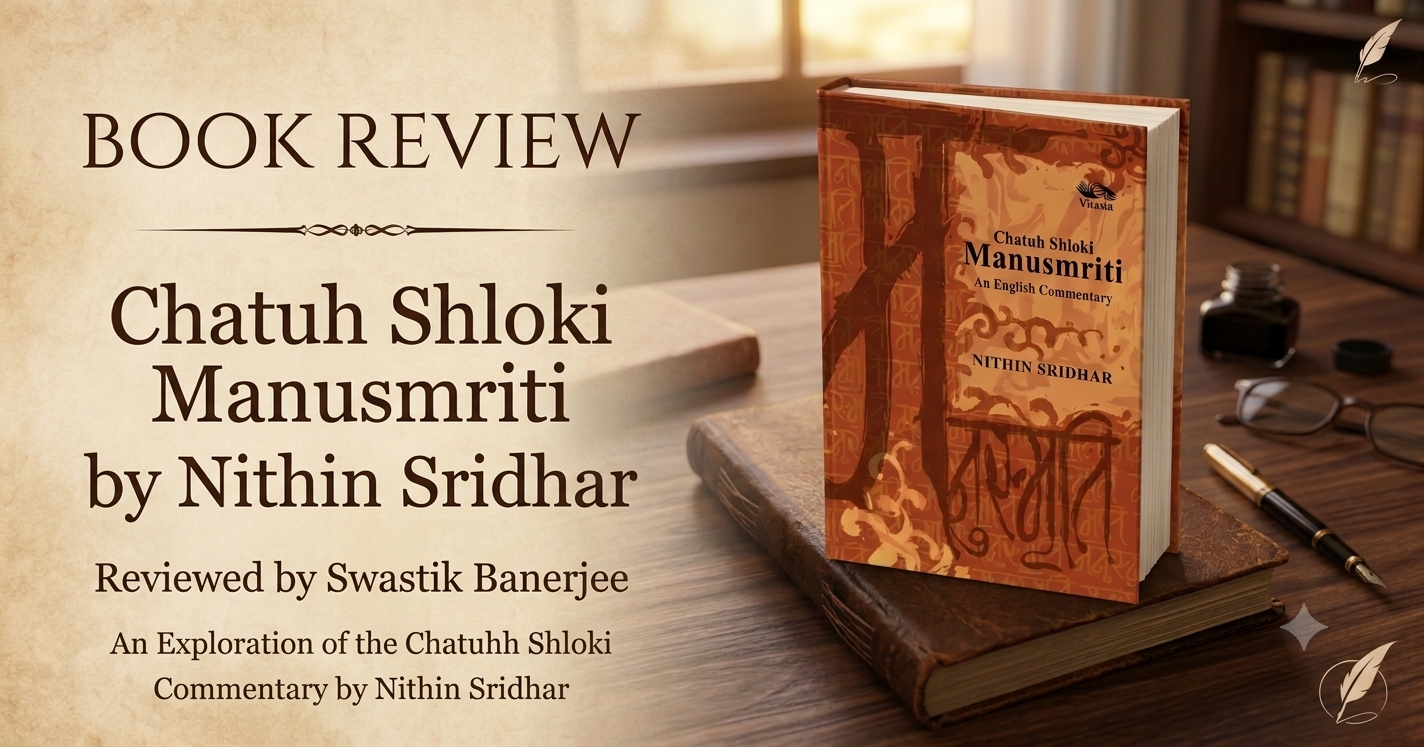
The Manusmṛti occupies a peculiar position in contemporary intellectual life. Few texts have been as frequently invoked, condemned, defended, or selectively quoted while being so rarely read. Public discourse on the text is conditioned almost entirely by ideological inheritance rather than textual engagement, a situation that has served neither its critics nor its defenders especially well. Nithin Sridhar’s Chatuh Śloki Manusmṛti: An English Commentary intervenes directly at this juncture. Rather than attempting an exhaustive treatment of the whole text, Sridhar focuses on the opening four verses, reading them as a compressed gateway into the Dharmaśāstra tradition and the conceptual framework that makes it coherent.
The book has been noted by several reviewers for its accessibility, its recovery of indigenous interpretive categories, and its resistance to colonial and post-colonial misreadings of Dharmaśāstra literature. These observations are fair, but they do not identify the work’s most significant contribution. What Sridhar is fundamentally doing is not defending the Manusmṛti; he is arguing for a particular account of how Dharmaśāstra ought to be read. That is a different, and considerably more ambitious, undertaking.
The methodological commitment is evident from the opening pages. Sridhar refuses to approach the text through the conceptual apparatus of modern constitutionalism, secular legal theory, or nineteenth-century Indological scholarship. Instead, he insists that the Manusmṛti must be understood through its own operative vocabulary, which in turn requires a prior reconstruction of how Dharma itself is categorised and theorised within the tradition. The result is a work that functions as much as a primer in Dharmaśāstric hermeneutics as a commentary on the four verses in question.
Among the more illuminating discussions is the treatment of the traditional tripartite division of Dharmaśāstric subject matter: Ācāra, Vyavahāra, and Prāyaścitta. Sridhar’s translations here are precise and purposive. Ācāra is rendered not merely as “conduct” but as the entire normative sphere encompassing duties, obligations, and the practices through which individual and collective life is sustained. Vyavahāra covers jurisprudence in the broad sense, namely legal procedure, dispute resolution, and social adjudication. Prāyaścitta concerns expiation, the mechanisms by which moral and ritual disruptions are rectified and equilibrium restored. Taken together, these categories establish that Dharmaśāstra cannot be reduced to a legal code; legal matters constitute one dimension of a far wider normative and cosmological framework.
The analysis sharpens considerably when Sridhar introduces the traditional classification of Dharmaśāstric content into dṛṣṭārtha, adṛṣṭārtha, dṛṣṭādṛṣṭārtha, nyāyamūla, and anuvāda. This taxonomy deserves careful attention because it exposes a distinction that is almost entirely absent from contemporary engagements with Smṛti literature. Dṛṣṭārtha concerns matters with observable and tangible consequences, typically relating to artha and kāma. Adṛṣṭārtha concerns matters whose consequences are not immediately perceptible, including puṇya, svarga, and mokṣa, and which therefore fall outside the criteria of empirical verification. Dṛṣṭādṛṣṭārtha combines both dimensions, while nyāyamūla and anuvāda refer to universal principles and authoritative restatements grounded in scriptural transmission.
The conceptual payoff here is considerable. Much contemporary criticism of Dharmaśāstra proceeds from the implicit assumption that Smṛti texts function analogously to constitutions or legal statutes, that is, as instruments for regulating observable social relations. Sridhar’s analysis demonstrates why that assumption generates a category error. Constitutional frameworks operate primarily within the sphere of dṛṣṭārtha; their authority is historically conditioned and their subject matter is, in principle, revisable by legislative procedure. Dharmaśāstra, by contrast, encompasses extensive discussion of adṛṣṭārtha: unseen causal relations, moral order, ritual efficacy, and the ultimate ends of human life. These domains are simply not assessable by the criteria applicable to modern legal or political institutions. The criticism that Dharmaśāstra is obsolete, when it has any determinate content at all, conflates the historically conditioned applications of Vyavahāra with the foundational concerns of Dharma as such. Sridhar provides a framework for keeping these distinct, which is a genuine analytical service.
A related contribution is the treatment of Dharma as a category embedded within a cosmological vision rather than an anthropocentric social arrangement. Throughout the commentary, Dharma emerges as an organising principle that coordinates cosmology, ethics, social structure, and spiritual aspiration into a unified, if complex, whole. This matters because a great deal of modern interpretation attempts to evaluate Dharma by isolating its social or legal content and submitting that content to external normative scrutiny, precisely the move that Sridhar’s analysis shows to be methodologically insufficient. One cannot responsibly assess a framework by criteria that the framework itself does not recognise as authoritative.
The book’s engagement with traditional commentarial literature is another strength. In treating the four verses, Sridhar undertakes a comparative examination of earlier commentators, bringing their interpretations into conversation with contemporary scholarship without either simply deferring to tradition or dismissing it. The method is neither antiquarian nor assimilationist; it models how traditional exegesis can be contextualised, compared, and evaluated. This will be of practical value to students and researchers working in Smṛti literature more broadly.
Indeed, the methodological significance of the work may ultimately exceed its immediate textual focus. The commentary repeatedly demonstrates, by example rather than merely by assertion, how Dharmaśāstric interpretation ought to proceed: how central categories should be defined, how commentarial disagreements should be weighed, how the relation between textual authority and contemporary understanding should be navigated. In this respect the work functions not only as commentary but as a guide to the field.
The appendices sustain this pedagogical function. The discussion of Varṇa is particularly notable: Sridhar surveys competing interpretations across multiple registers, covering social function, birth-based ascription, and metaphysical accounts of embodied being, without resolving the tensions prematurely. Whether all his conclusions are persuasive is a secondary question; the analytical seriousness with which difficult material is handled is not in doubt.
There is a further observation worth making. The author argues that contemporary discomfort with the Manusmṛti often reflects less a considered engagement with the tradition than a long-standing disconnection from Dharmaśāstric modes of thought. This is a claim that will be contested, but the underlying philosophical point is sound: serious criticism requires prior understanding. To reject a conceptual tradition whose categories one has never seriously examined is not critical rigour; it is intellectual reflex.
Chatuh Śloki Manusmṛti: An English Commentary succeeds on several fronts simultaneously. It serves as an introduction for newcomers, a corrective to entrenched misreadings, a methodological guide for students of Dharmaśāstra, and a philosophical reflection on the nature of Dharma as a category of thought. Its central argument, namely that the study of Smṛti requires genuine engagement with the conceptual universe from which these texts emerge rather than the external application of inherited frameworks, is not merely defensible but overdue. For scholars, students of Indian knowledge systems, and readers with a serious interest in the intellectual foundations of the Hindu tradition, this is a significant and timely contribution.