
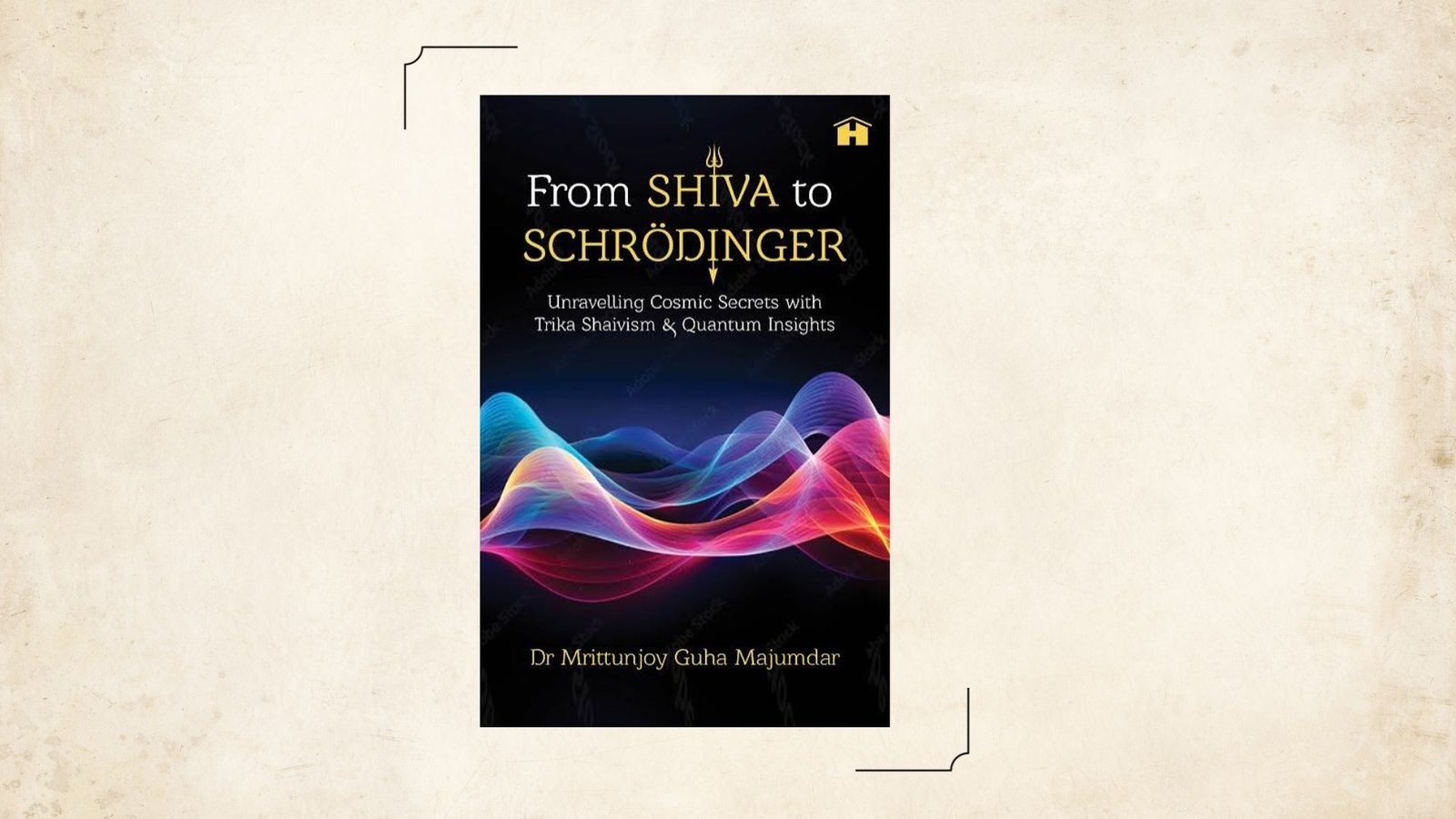
It is often said that science and spirituality are locked in a permanent battle. This idea is known as the “conflict thesis”, and it grew mainly out of Western history, where religious authority and scientific discovery clashed in some famous cases. The reality is far more nuanced than a simple war between two sides. Many scientists have been deeply spiritual, and many spiritual traditions have encouraged careful questioning and direct observation. Dr Mrittunjoy Guha Majumdar’s book From Shiva to Schrödinger shows this very well from an Indian point of view. It does not treat science and spirituality as enemies, and it does not try to make one defeat the other. Instead, it places Indian philosophy, especially Trika Shaivism, beside modern quantum physics and lets the two speak to each other. Ideas such as non-duality, interconnectedness and the role of the observer appear in both conversations, even though they are expressed in very different languages. The author explains these ideas in clear, simple words, so even a reader with no background in either field can follow. By the end, we see that Indian thought has long moved alongside the questions science asks about reality, mind and the universe. This makes the book a welcome and refreshing read for anyone tired of the old “science versus religion” argument.
About Trika Shaivism
The first chapters look at Trika, the philosophical basis of Kashmir Shaivism, and set out its basic ideas in easy to understand language. The structure is based on three main principles: Shiva, which stands for pure consciousness; Shakti, the creative power behind existence; and Anu, the individual soul. It is these three principles that lead to the formation of the 36 tattvas, which stand for the various stages ranging from subtle awareness to the physical world. The text also mentions spanda, the original vibration that starts creation, and shaktipata, the descent of grace which brings about spiritual awakening.
The author provides a historical context for these ideas by tracing the origins and development of the tradition and by pointing out the scholarly lines of succession, among others mentioning Vasugupta and Abhinavagupta, who have kept these teachings alive over the generations.
The book also gives an important explanation regarding Trika’s view of the material universe. Unlike the traditional Vedic schools which consider the physical world to be illusory, Trika holds that the universe is a true and dynamic expression of Parama Shiva. The physical world is seen as the ultimate reality in terms of manifestation. This way of looking at things is put into practice using various systems such as the Yamala and Shakti tantras, Abhinavagupta’s three symbolic forms (vyakta, vyaktavyakta, and avyakta), and the Kaula practice, which focuses on three basic powers.
Consciousness as the Primary Ground
A central thesis of the book is that consciousness is not simply a byproduct of biological processes, but rather the foundational reality of existence. The text delineates three progressive levels of awareness para, para-apara, and apara, each representing a distinct degree of the same underlying consciousness. These are contrasted with the four experiential states: waking, dreaming, deep sleep, and turiya, the witnessing This perspective is connected to Para-vak, the primordial sound from which form arises, and to the relationship between pramata (the knower) and prameya (the known). Trika conceptualizes awareness as an active force, characterized by the interconnected processes of knowing, willing, and feeling.
Rethinking the Subject-Object Divide
The book looks at the line that separates the observer from the external world and considers various approaches to this problem, mentioning John Searle’s analysis of subjective existence and objective knowledge, Mahayana Buddhism’s emphasis on emptiness, and Shankara’s Advaita philosophy of non-dual oneness.
Trika’s particular method, known as pratyabhijna (recognition), does not aim at getting rid of the distinction between the self and the world, but rather seeks to bring about the understanding that this separation is in fact illusory; since all phenomena depend on a common fundamental field, pratyabhijna is able to resolve the apparent contradictions between unity and diversity as well as between the transcendental and the ordinary; the perception of a complete separation is finally seen as an illusion produced by the ego.
Why Classical Physics Shifted
The text subsequently transitions to the historical development of modern physics. Newtonian mechanics provided effective explanations for macroscopic phenomena, such as planetary motion and everyday objects, but proved inadequate at the microscopic scale. In 1900, Max Planck introduced the concept that energy is emitted in discrete quanta rather than continuous waves. Building on Planck’s work, Heisenberg and Schrödinger formulated quantum mechanics, which underpins technologies such as transistors, lasers, and quantum computing.
The book examines two foundational quantum principles: superposition, which posits that a system exists across multiple potential states until measured, and uncertainty, which demonstrates that certain pairs of physical properties cannot be simultaneously determined (it is impossible to simultaneously measure both the exact position and the exact momentum of a subatomic particle). The author emphasizes that uncertainty is an intrinsic feature of nature, not a limitation of measurement instruments.
The Mechanics of Entanglement
The section dealing with entanglement is one of the most thoroughly discussed in the book. Once two particles are entangled, taking a measurement of one at once gives information about the other, no matter how far apart they are. This effect caused Einstein, Podolsky and Rosen to put forward the EPR paradox in 1935 and to claim that quantum mechanics was incomplete. Later on, Bell’s theorem offered a means of testing these ideas experimentally. The book then goes on to consider the main experimental loopholes locality and freedom of choice and demonstrates how modern experiments have systematically dealt with them.
The text outlines how entanglement powers practical applications, including secure quantum communication, faster computation, precision measurement, and advanced biological research. At the same time, the author clarifies a common misconception: while entangled states display strong correlations, they cannot be used to transmit actual information faster than the speed of light.
Decoherence and the Everyday World
The reason why we do not observe quantum effects such as superposition in ordinary life is that the book refers to decoherence, when a delicate quantum system comes into contact with its environment it becomes entangled with it and promptly loses its superposition, together with the energy and phase relationships spreading out into the environment.
To deal with decoherence, physicists use methods such as error correction, fault-tolerant designs, and particular types of area known as decoherence-free subspaces. There are instances in which environmental noise is employed in order to enhance quantum sensing. The book concludes this section by connecting vacuum fluctuations in quantum fields with dark energy and the expansion of the universe, illustrating that the transition from quantum physics to ordinary physics is gradual rather than occurring all at once.
Where the Two Traditions Intersect
Once both systems are explained, the author compares them directly and introduces the term Quantrika for the ideas that connect them. The primary parallels emerge through distinct theoretical pairs:
- Non-duality and Entanglement: Trika’s concept of non-duality aligns with quantum entanglement and non-locality.
- Observer and Observed: The relationship between knower and known reflects the observer effect in physics.
- Dynamic Reality: Shakti’s continuous cycle of creation and dissolution mirrors wave-particle duality.
- Uncertainty and Maya: The ego’s illusion of separateness parallels the limits imposed by uncertainty.
- Unified Consciousness: Timeless, pure consciousness corresponds to the concept of a unified quantum field.
The discussion extends beyond Indian philosophy to include western thinkers like Heraclitus, Parmenides, and Nietzsche, as well as modern figures such as Krishnamurti and Ramana Maharishi. In physics, it compares the Copenhagen interpretation which says measurement turns possibilities into reality with Bohmian mechanics, quantum field theory, and string theory. The book also discusses current debates about the measurement problem, wave-function collapse, and the direction of time.
The author maintains a critical distinction between the two fields: Trika seeks personal liberation through inner practice, while quantum physics tries to explain the physical world through measurement. He lists seven practical ways to combine both views and suggests that seeing these links can help us feel more responsible for the world.
Perception, Practice, and Consciousness Studies
The text points out that Trika does not adopt absolute dogmatism since it recognises that understanding is dependent on context and experience. It places greater value on pratyaksha, which refers to direct and immediate perception, than on logical inference alone or on traditional scriptures. It describes specific practices such as meditation, pranayama, and yoga as ways of eliminating mental clutter and improving perception.
This moves into a discussion about intention and experience. The author looks at how focus, mindfulness, living ethically, and personal choices shape our daily lives. This part tries to connect personal action with the bigger ideas of physics, offering thoughts that challenge usual boundaries.
The book ends by looking at the relationship between neuroscience and computing, covering subjects including artificial neural networks, quantum neural networks which make use of superposition, the neural correlates of consciousness, and Giulio Tononi’s Integrated Information Theory. The author argues that even though current science is still examining the connections between brain activity and mental states, ancient views such as Trika offer valuable insights by considering consciousness as a basic principle rather than as a secondary occurrence.
Where the Parallel Stretches Thin
A careful reader must maintain a clear distinction between metaphor and equivalence. A shared concept does not mean a formal proof. Metaphysical terms like Shakti represent philosophical claims, whereas energy in physics is a specific quantity calculated with mathematical equations. Similarly, quantum entanglement describes verified mathematical correlations between physical particles, which is distinct from spiritual claims about global oneness.
The analogies are taken the farthest when it comes to linking mental intention directly to physical results, since ordinary quantum mechanics does not claim that human thoughts change the physical laws. The author himself recognizes these differences in methodology and aim, which in turn helps maintain a realistic tone.
Final Thoughts
From Shiva to Schrödinger is effective because it approaches both subjects with intellectual rigor and respect. The book avoids using physics to superficially validate spiritual claims and equally refrains from dismissing traditional philosophy as mere superstition. By systematically presenting the fundamentals of Kashmir Shaivism and quantum mechanics before drawing connections, it offers a thoughtful framework for interdisciplinary inquiry. The work serves as an engaging invitation to explore the nature of reality from two distinct yet complementary perspectives.
Dr. Majumdar avoids both extremes. He gives Kashmir Shaivism the philosophical respect it merits while maintaining quantum mechanics within the domain of empirical science. Instead of forcing a superficial alignment, he presents them as two distinct and insightful approaches through which humanity seeks to understand existence.it encourages readers to reconsider fundamental questions such as just how much our perception influences reality and whether the boundary between ourselves and the outside world is actually as clear as it appears.
Fundamentally, the book fosters a genuine sense of curiosity. It highlights that whether one is analyzing data from contemporary physics experiments or engaging in meditation, both pursuits address the same underlying mystery. The work is thoughtful and engaging, leaving a lasting impression on the reader.

