- Visitor:67
- Published on: 2025-12-06 03:25 pm
Syncretic Nature of Religions in Japan
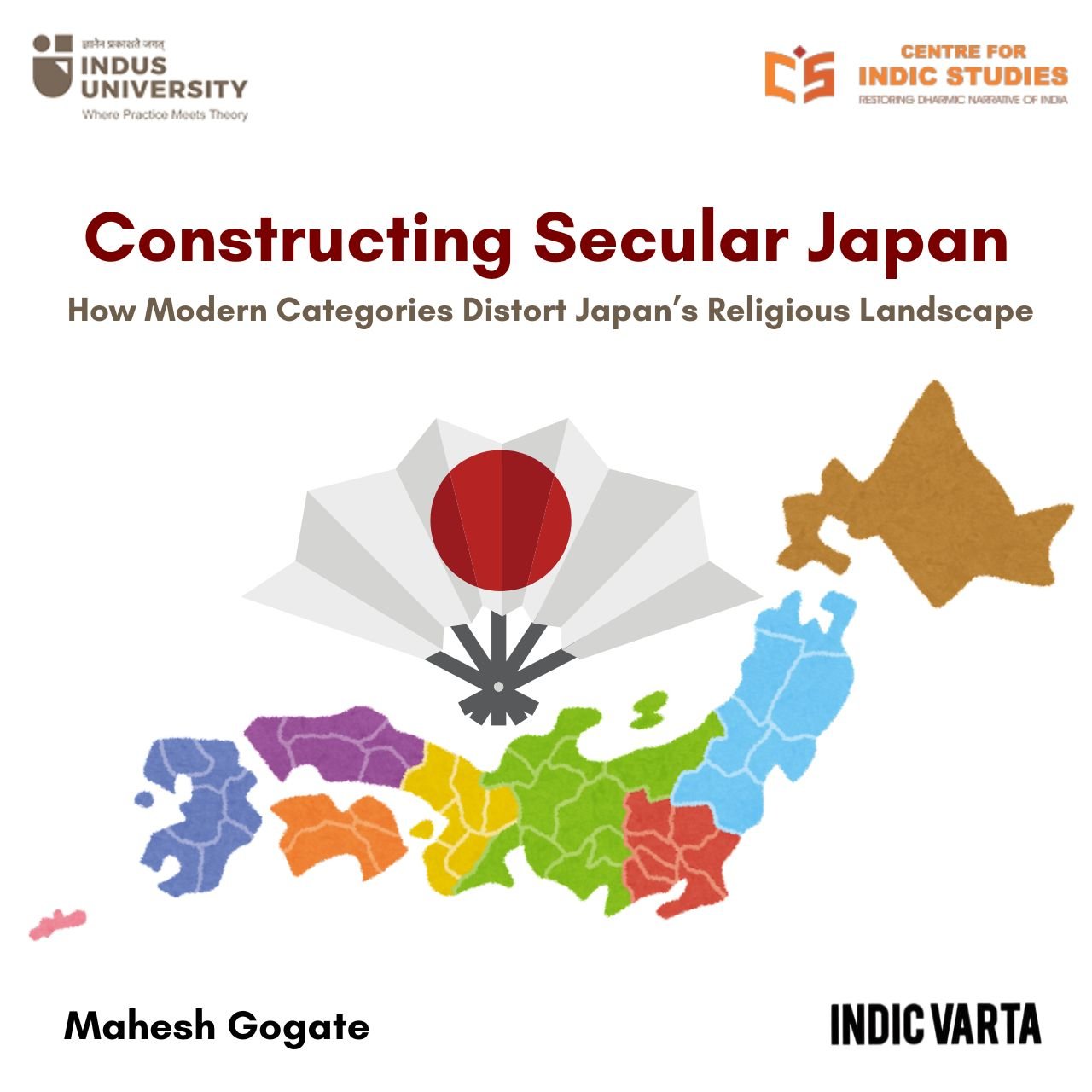
This essay interrogates claims that Japan is ‘non-religious’ by tracing the encounter between traditional syncretic practices and imported monotheisms. It shows how Western categories—religion, secular, atheist—were imposed during modernisation and colonial exchanges, producing conceptual confusion and misleading survey results. Problems in measuring religiosity stem from inadequate sampling and reliance on doctrinal metrics unsuited to ritual-centred Japanese sensibilities. The challenges associated with translating theological concepts from Western religious traditions underscore the issue of category mismatch. This essay presents a re-examination of historical, linguistic, and survey evidence in support of the argument for a reframing of religious nomenclature. This re-framing would capture concepts of syncretism, embodied rituals and plural belonging. Furthermore, it is posited that this reframing would inform more sensitive comparative methodologies.
- Share on:


Introduction
Last year in October 2023, The Associated Press published an article titled “In secular Japan, what draws so many to temples and shrines? Stamp collecting and tradition” written by Mari Yamaguchi. The title of the article epitomises the flawed understanding of the religious culture of Japan and the deep impact of the Western idea of the separation of religious and secular. When discussing religions in Japan, we often encounter phrases like Japan being ‘the least religious’ or Japanese people being ‘not religious.’ The routine narrative that dominates the English discourse routinely portrays Japan as a secular and atheist country where ‘religion’ does not exist or rather it has already ‘died out.’ This paper therefore revisits the religious history of Japan to understand how the arrival of ‘revealed’ or monotheistic religions in the Japanese archipelago hugely transformed the religious understanding and engendered a great confusion in the Japanese mind.
The survey published in 2009 conducted by the International Social Survey Programme (NHK Broadcasting Culture Research Institute) on religion revealed that around 49 per cent of Japanese respondents ‘do not follow any religion.’ A decade later, as per the Pew Research Center surveys (2008 to 2017), only 10 per cent of the total population say that ‘religion is very important in their lives.’ The other contemporary survey conducted by the Japanese General Social Survey (JGSS. 2017-2018) showed that nearly 71 per cent of the respondents ‘do not practice religion’. In the World Values Survey Wave 7 (WVSV. 2017-2020), when asked about the religious denomination 63 per cent of respondents said that they are ‘non-religious.’ Despite whether they go to a ‘church’ or not the same survey revealed that more than 55 per cent of the respondents identified themselves as ‘not a religious person.’ About 19 per cent of respondents answered that they are ‘atheists.’
However, the results of these surveys are contradictory with the 29 religious sites and 44 religious structures designated by the Agency for Cultural Affairs, Government of Japan and about 160,000 active shrines and temples witnessing large gatherings of people during the time of festivals and other annual events. The Religion Yearbook 2023 (in Japanese) states that “Japan is home to a wide variety of religious cultures, including Shinto, Buddhism, Christianity, and various religions.” The Religion Yearbook uses the term ‘religious cultures’ and elucidates the brief history of various religious cultures of Japan. When discussing the number of ‘believers’ and ‘religions’ in Japan there is one peculiar fact that needs to be highlighted. In 2023, the total population of Japan was 124.63 million. However, as per the Religion Yearbook the total number of ‘believers’ was about 162 million which was more than the total population of Japan.

Figure 1. Fushimi Inari Taisha (Shrine), Kyoto City, Japan. Photo by the author.
The previous research has discussed the notion of religion, measuring religiosity, different social surveys, and the limitations and inconsistency among their results. Roemer (2009) argued that insufficient sample size and limited access to individual data hinder the careful analysis of religion in Japan and it continues to remain ‘under-researched.’ “The syncretistic nature of Japanese religiousness, writes Roemer, also helps explain why exclusive religious affiliations are uncommon in Japan.” These inconsistencies, therefore arose when the strong adherence was given to the monotheistic ideas and preconceived Western notions of religion and its principles. During the colonial conquests, Western parochial terms such as ‘religion’ and ‘secular’ were foisted on non-Western cultures or rather on uncivilised nations. During the end of the twentieth century, wide-ranging Western thoughts and the push for modernisation flowed into Japan. This triggered a lot of churning and confusion in categorising and finding the Japanese corresponding nomenclature. Sansom (1951) gives an example of finding the most suitable counterparts for biblical terms such as ‘God’, ‘spirit’, ‘atonement’, ‘grace’, etc. and how the verbatim translation of the texts created absurd meanings in Japanese. I therefore suggest that we need to revisit this great conundrum and perhaps find the genesis of making Japan a ‘non-religious’ and a ‘secular’ country.
Shinto and introduction of Buddhism
The pottery, ceremonial artefacts and other relics discovered during excavations at various archaeological sites in Japan date back to the Yayoi period (400 BC - 300 AD; approximately). During this period, rituals and practices were closely linked to rice cultivation. Japanese minds were aware of and experienced the presence of divinities in their natural environs. For that reason, ritual sites were located close to perennial water sources such as riverbanks, and waterfalls and also at hills and mountains. At these sacred sites, ‘Kami’ was manifested in responding to human invitations and various rituals offered. Herbert (1967) refrained from translating the term Kami into the English word ‘god’. He states that the Japanese mind does not necessarily need explicit conceptualisation of Kami. Kami is without any forms and is not visible. The Japanese expression for Shinto is ‘Kami no michi’, which stirs many theories and discussions about how to construe it into English. Roughly, it can be explained as ‘ways of the divinities.’ Shinto thoughts and practices are deeply connected with agriculture and power of fertility and revering the sacred nature and natural phenomena. Human nature as per the Shinto is essentially pure and affirmative, which is in contrast to the Christian doctrine of ‘original sin’. Yamakage (2012) argues that Shinto philosophy without any founder, idols, doctrines, or commandments has suffered the “tragedy of not-having-any” and this led to labelling Shinto as a ‘non-religion’ by many domestic and international scholars.
The scholars have studied and discussed two extant prominent works called, ‘Kojiki’ (Records of Ancient Matters) and ‘Nihonshoki’ or ‘Nihongi’ (Chronicles of Japan), dated early eighth century, conceive the Shinto cosmology and talk about the celestial and terrestrial deities. The composing period of these texts also draws attention to the facts that the systematised arrangements and crystallisation of literary texts commenced after the introduction of Buddhism (Mahayana school of thought mainly) from the Korean peninsula during 538 C.E. or 552 C.E. Before the entry of Buddhism, sacred areas in the proximity to nature were considered as ‘shrine’; the English term for Shinto structure, with a sacred object such as a rock or tree worshipped by the people. The entry of highly organised Buddhism and its monastic cultures triggered many transformations in Shinto and arguably the title Shinto was also formally accepted. The development of art, architecture, rituals, and voluminous scriptures in India, Central Asia, and China attracted the rulers and royal court of Yamato.

Figure. 2. The Kamo Wakeikazuchi Jinja (more commonly referred to as the Kamigamo Jinja) can trace its history back more than 1300 years, thus classifying it as one of the oldest Shinto shrines in Kyoto, Japan. Photo by the author.
Despite the earnest Shinto believer and follower of Shinto, both Emperor Yomei (540-587) and his son Prince Shotoku (574-622) were considered the founders of Buddhism in Japan. As per the ‘Nihonshoki’ Emperor Yomei even converted to Buddhism. The propagation of Buddhist philosophy and practice continued during the regime of Emperor Shomu (701-756) and during this era (termed as Nara period, 710-784) temples such as, Horyu-ji and Todai-ji were built and Buddhism acquired national status without abandoning the Shinto culture and honouring the rites of Kami. The complex relationship between Shinto and Buddhist thought, and the blurring of the boundaries between the two also occurred during this period. Influenced by various schools of thought, some Kami-s came to be interpreted as manifestations of Buddhas and Bodhisattvas. Despite the philosophical differences and rivalries between the Shinto and Buddhists, Japanese people eventually brought both these practices and rituals into their mundane lives by performing Kami worship at Shinto shrines and performing funeral rituals at Buddhist temples. The Japanese proverb ‘born Shinto die Buddhist’ encapsulates the cultural practices and religious composition. This phenomenon also draws attention to the fact that ritual practices are one of the most common manifestations of Japanese religiousness. The Kamakura period (from the end of the twelfth century through the middle of the thirteenth century) saw the appearance of prominent Buddhist scholars and eight schools of Buddhism aptly called ‘Kamakura Buddhism’. From its introduction in the sixth century, during the Kamakura period, Buddhism was eventually assimilated into the Japanese way and penetrated society.
Arrival of Confucian and Tao philosophies
Along with Buddhist philosophy, Confucian and Tao philosophies and practices also arrived in Japan and were later adopted into Japanese practices. Regardless of the differences in the notions, the multiplicity of the Japanese mind adopted and absorbed these divergent philosophies and eventually turned them into the Japanese model. The mindful and unwitting in both ways, the royal court and families, and ordinary people at large borrowed and altered various practices, rituals, teachings, and ideas from different traditions at different times.
The innate Japanese nature of reverence for nature was further reestablished by adapting the Confucian and Zen (Ch’an) teachings. The Zen philosophy is worth highlighting to expound the syncretic nature and conscious embracing of diverse practices in Japanese culture. Masunaga (1956) has brilliantly condensed the trajectory of Zen philosophy and its profound impact on Japanese aesthetics.
“Zen combined the intellectual culture of India, the pragmatic culture of China, and the emotional culture of Japan in a movement which influenced architecture, sculpture, painting, calligraphy, flower arrangement, gardening, Noh songs, poetry, music, and pottery.”
However, Earhart (2004) calls attention to this ‘borrowing’ practice which fundamentally signifies two viewpoints; firstly, the embraced thoughts complemented the Shinto philosophy and secondly, these ‘foreign’ concepts integrated deeply and lost their root identities.
Centuries of Isolation and Christian Missionaries
The sixteenth century was a compelling era which cannot be overlooked to understand the problems posed by the ‘foreign religion’ especially before the three prominent leaders; Oda Nobunaga (1534-1582), Toyotomi Hideyoshi (1537-1598), and Tokugawa Iyeyasu (1542-1616) who strived to unify Japan under their leadership. Christianity, chiefly it was Roman Catholicism entered Japan and this initial era was coined as ‘kirishitan’ in the Japanese language. In this same era, Japan was witnessing greater uncertainty due to wars and shifting of loyalties. During this volatile period, in 1549 Roman Catholic Jesuit missionary Francis Xavier (1506-1552) landed in Kagoshima, Japan and began the missionary work by baptising people and establishing a church. Francis Xavier was dejected by the missionary conditions and its progress in India and was in search of a new territory. He realised that imperative political power was crucial for the promotion of the evangelical mission and that converting the Shogun and feudal lords of Japan would bring success. Oda Nobunaga wanted to unify Japan and had difficult and bitter relationships with some of the armed Buddhist monastery fraction. Many scholars believe that the ulterior favour shown by Nobunaga towards the Catholic missions was to curb the aggressive Buddhist monasteries.
Hideyoshi succeeded Nobunaga and initially showed a favourable attitude toward missionary activities. It is an intriguing fact that even many close high-ranking generals of Hideyoshi’s were baptised. However, the incidences of political interference and increasing suspicion around missionary activities forced Hideyoshi to persecute the missionaries. In his reply to the letter received from the Viceroy of the Indies (the Portuguese governor of Goa, India), Toyotomi Hideyoshi expressed the core philosophy grounded on the teachings of virtues and spirituality and the intrusion of the foreign religion to destroy these notions. He writes,
“Ours is the land of the Gods, and God is mind. Everything in nature comes into existence because of the mind. Without God, there can be no spirituality. Without God, there can be no way. God rules in times of prosperity as in times of decline. God is positive and negative and unfathomable. Thus, God is the root and source of all existence. This God is spoken of by Buddhism in India, Confucianism in China, and Shinto in Japan. To know Shinto is to know Buddhism as well as Confucianism.”
The essence of Japanese thinking can be observed in this document, which demonstrates a profound respect for the interconnectedness of diverse philosophies, and an organic process of adaptation and synthesis. A Portuguese long-time missionary Luís Fróis (1532-1597) who interestingly was contemporary to Hideyoshi, wrote in detail on the cultural differences between Japanese and Western Europeans. Fróis in his accounts conveniently ignores the clashes at home and writes, “We profess only one God, one faith, one baptism and one Catholic Church; in Japan, there are thirteen sects and almost all of them disagree on worship and veneration.” This exclusive hidebound Western approach of compartmentalisation failed to comprehend the diversity of thoughts, rituals and traditions.
Tokugawa Iyeyasu after the death of Hideyoshi established the Tokugawa shogunate. Davis (1916) makes a compelling argument to elucidate why the persecution of missionaries continued despite the regime change. He explains that Japan listened patiently to the sermons of the Roman Catholic missionaries till it made a sense of new religious teachings. However, when the Christian missionaries started manoeuvring the political forces then they started facing suppression. Davis mentions the Dutch merchants who were pragmatic and did not mix religion with trade and commerce. Therefore, the Dutch were permitted to even stay at Hirado and later at the artificial port called Dejima at Nagasaki. Iyeyasu and his Tokugawa shogun successors suppressed missionary activities, particularly in the Kyushu region, where the Church had a strong presence. This era is referred to as the Edo period (1603-1868) which lasted for more than 260 years, when island nation Japan closed all its ports (Sakoku) and exercised tight control on trading with foreign countries except only with the Netherlands and China. In this period of seclusion, restrictions were tightened on the spread of foreign religions in Japan. During the roughly two hundred years period, Buddha and Kami were brought into a ‘common Pantheon’.
Era of Restructuring, Restoration and Adaptation
After banning the ‘kirishitan’ the shogunate ordered all the temples to submit the ‘statement of affiliation’ and it was made compulsory to all the households to affiliate with a particular temple. Buddhist schools seized these opportunities and allied with the regime. However, the proximity to the shogunate made a deep impact on the practices and spiritual standing of Buddhism. During the end of the Edo period, after the downfall of the Tokugawa shogunate’s supremacy, Buddhist schools also lost their patronage and Japan witnessed the revival of Shinto.
Just a few years before the Meiji era, in 1853, Commodore Matthew C. Perry with his four American ships reached Japan and in 1854, finally succeeded in opening the two ports for American vessels. The entry of American vessels into Japanese water finally ended the self-imposed seclusion of Japan and started the confrontation with ‘modernisation’ and ‘Westernisation.’ During the nineteenth century, the European powers along with their superior culture (with the Christian teachings) and civilisation were on a mission to civilise the uncivilised territories. This era witnessed the emergence of ‘International Law’ which posed a threat to the sovereignty of many uncivilised countries. In 1858, The United States and Japan (during the Tokugawa regime) signed the ‘Treaty of Amity and Commerce.’ Japan being categorised as an ‘uncivilised’ nation, had to terminate its policy of seclusion and was compelled to sign the unequal treaty.
It is interesting to mention that in the previous treaty of 1854, President Fillmore of the United States cognisant of the longstanding hostility to Catholic Christian missionary activities instructed Commodore Perry to submit to the Tokugawa regime that the US unlike other Christian countries did not interfere in religion at home and in foreign countries and therefore not mentioning the term religion in the treaty. Till then, the term ‘religion’ in diplomatic documents was never translated as ‘shukyo’; which is now the contemporary and prevailing rendering in the English language. After the opening of the country to the Western world the original Buddhist ‘shukyo’ term was transformed into the ‘Western’ term ‘religion’.
In 1867, Mutsuhito (1852-1912), merely at the age of fifteen years, became Emperor Meiji, marking the restoration of direct imperial rule. The period of forty-four years (1868-1912) is commonly referred to as the ‘Meiji Restoration’ era. During this period of restoration, the Meiji government established the ‘Department of Shinto’ (which was replaced by the Shinto Ministry and subsequently by the Religious Board) and Buddhism was separated from the Shinto. This exercise and policy favoured an atmosphere for Shinto to emerge as a national religion. Shinto shrines were ‘nationalised’ at the beginning of this restoration era and thus the term ‘State Shinto’ came into existence.
During the period of seclusion, Western thoughts and knowledge entered through Dutch learning (Rangaku). To compete with the growing Western powers, many scholars, political leaders, and influential people started advocating ‘Western learning’ and ‘Scientific education’ in the newly opened era. The leaders from Buddhism and Christianity saw this crucial time to strongly argue for ‘modernity’ as it would pave the road for Japanese enlightenment and counteract Shinto dominance.
Here it is important to revisit Kishimoto’s (1960) premise on ‘Westernisation’ and ‘modernisation’ which he argues, are fundamentally different in nature. However, he elucidates that the ‘Western culture’ is a seamless synthesis of Westernisation and modernisation. Kishimoto traces the transformation of Christianity and how it was rearranged and re-introduced as a ‘modern religion’ in Japan. This has facilitated shaping an initial perception that Christianity, Westernisation, and Modernisation are cut from the same cloth. Some of the torchbearers of the Meiji era converted to Christianity to fulfil their aspirations of studying English and experiencing Western culture. It is somehow evident when in 1888, the complete Bible in the Japanese language was published and along with the converts, the non-Christian Japanese referred Bible for their English language studies and to perceive Western thoughts. Subsequently in his writings, Kitagawa (1966) elaborates on the failure of missionaries as they did not acknowledge that ‘Christian’ and ‘Western’ are two distinct values and naively wished that Christian preaching and Western Christian culture would proselytise the Japanese ‘pagan’ culture. Even though, proselytising the Japanese pagan culture never transpired, Kitagawa mentions the influence of Japan’s urban elite who distinguished the ‘modernity’ was the impetus behind the ‘Western secular civilisation.’ These urban elites noticed the similarities between the feudal rule of the Tokugawa dynasty and the Monarchies of the Middle Ages which were subservient to the Church.
Isomae (2014) discusses the contribution of some of the notable scholars from the Meiji period, like Shimaji Mokurai (1838–1911); a religious advisor to the government, and Inoue Kowashi (1843–1895); who was part of the committee that drafted the constitution, and how both of them analysed the disparities amongst the Western nations regarding the religion and political systems. Many of these Japanese scholars studied in different European countries. They closely observed the different levels of tolerance and theories about the ‘separation of state and religion.’
Separating Shinto and State
In 1945, Japan surrendered to the Allied Powers which marked a watershed moment. It had a deep penetration of US policies and modern thoughts, particularly about religion and its significance. After the end of World War II, the Allied Powers removed Shinto education from schools and eliminated the ‘State Shinto’ or ‘Shrine Shinto’ as they were convinced that separating Shinto from the state was essential to build a ‘peaceful democratic Japan.’ The Religions Division and Allied Powers arguably failed to comprehend the omnifarious traditions and thoughts of Shinto. The prejudiced views and wartime propaganda equated Shinto teachings with extreme militarism and jingoism.
Immediately after the end of the war, during the occupation time, missionaries started returning to Japan to rebuild their structures and resume their outreach programs. The missionaries received assistance and support from the Supreme Commander for the Allied Powers (SCAP). Woodard (1972) in his book, investigates the dominating role of General MacArthur who was the Supreme Commander and reveals MacArthur’s firm faith in Christianity. Woodard discusses MacArthur's views on the indigenous faith and mythological teachings in Japan and how he strongly believed that evangelical work was required to establish democracy in Japan. In one of the cables sent to “Youth for Christ” on 24 February 1950 MacArthur writes,
“My often-repeated conviction reminds unchanged that acceptance of the fundamental principles of Christianity would provide the surest foundation for the firm establishment of democracy in Japan. therefore, (the) distribution of scriptures and interdenominational evangelistic rallies carried on in cooperation with established religious missions capable of providing continuing follow-up (is) highly welcome. Entry into Japan of Youth for Christ will be welcome on (the) same basis as other operating missionaries.”
It is apparent from the several speeches given by MacArthur and the policies of General Headquarters (GHQ) of the SCAP about their unfair treatment of Shinto and favouring Christianity which seriously destroyed Japanese thoughts and practices. The implementation of the ‘separation of state and religion’ as an essence of ‘Western enlightenment’ also changed academia where universities and colleges started withdrawing from the ‘religious studies’ and thereafter relocating the contents of religious studies in the way of ‘American-style’ social sciences. Isomae (2014) discusses the ‘practice-oriented’ and ‘doctrine-oriented’; two categories of the translations of the term ‘religion.’ The term ‘shukyo’ was doctrine-oriented and was limited to academic circles. Isomae argues that the acceptance of the restricted significance of the ‘doctrine-oriented’ term ‘shukyo’ superseding the ‘practice-oriented’ terms marks the essential shift in Japan. According to Isomae this translation exercise and appropriating decision was heavily influenced by the European divisions of civilised, uncivilised and primitive nations. Christianity which is the essential part of the Western concept of religion is significantly a belief and doctrine-oriented religion. The formalisation of the term ‘shukyo’ drifted away from the ritual and practice-oriented nature rooted and developed in Japan.
Concluding remarks
This paper has revisited the religious history of Japan and attempted to map the trajectory of the arrival of diverse philosophies, thoughts, and practices in different eras and their impact on Japanese culture. This paper tries to highlight the contrasts between thoughtful, practising, and syncretic minds against the highly organised and doctrine-based theocratic force. In Japan distinguishing the sacred and secular is a futile exercise. The arrival of Christian missionaries and later the penetration of Protestant ideas ‘believing’ dominated the worshipping practices and rituals. Toshimaro (2005) classify the Japanese religious culture as ‘natural’ religions which are essentially difficult to define as opposed to ‘revealed’ religions. Toshimaro argues that if religion is looked through the lenses of the revealed religions such as Christianity or Islam then traditional festivals linked with Shinto fail to recognised as a religion. According to Toshimaro when a Japanese identifies himself or herself as ‘non-religious’ he or she is essentially distancing himself or herself from revealed religions. Toshimaro also has advice for the Japanese who travel abroad to remember that ‘non-religious’ is an identifying oneself with natural religions and their rich religious sensibility.
- 33 min read
- 2
- 0