- Visitor:81
- Published on: 2025-09-30 04:15 pm
Sri Ram’s Akal Bodhan: From Earthly Rituals to Martian Adaptation
The plot is set in the year 2137 on Mars. In it, the story explores how atheists repeatedly challenge religions with questions such as: If holy centers like Mecca or Jerusalem no longer exist in their earthly form, in which direction should one pray? How will ritual timings be calculated in a new planetary environment? Against this backdrop, it narrates how the ancient concept of Akal Bodhan: the untimely invocation guides humanity’s survival after a devastating solar flare strikes a Martian colony. Above all, the story depicts how human beings may once again turn to ancestral rituals, adapting and reinterpreting them, to rebuild and sustain their civilization on Mars.
- Share on:


Sri Ram’s Akal Bodhan: From Earthly Rituals to Martian Adaptation
The year will be..is.. sorry… was 2137: what I will be talking about now today…
Mars Colony Ananta glowed faintly against the red dust plains by now and its bio-domes breathing like fragile lungs under the thin sky. For thirty years, settlers from India, Afganistan, Pakistan, Nepal,Bhutan, Tibet, Sri Lanka and Bangladesh had nurtured this outpost of the new Earth… doing many things like planting crops, raising children and carrying their festivals across the stars and many more.
Now, you will find here that by Mars Year 30, the colony cafeterias had become the debating halls of humanity. Between recycled-air coffee and hydroponic spinach pakoras, the old arguments between science and religion resurfaced… only now they echoed under a pale Martian sky.
Until one day…
“Tell me this,” joked one atheist between a discussion, sipping his algae latte. “Did God also create Olympus Mons and Valles Marineris? Or are they just by-products of physics and volcanic outgassing?”
The local priest, flown in years ago to tend to the spiritual needs of the settlers, cleared his throat and frowned. “Everything is in God’s plan.”
That only encouraged the others. “Right,” said another colonist with mock seriousness, “but if we find microbes in that briny crater, are they also in the plan? Or just cosmic freeloaders riding on evolution?”
What to say… the priest humbly folded his hands. “Look young boy… let me tell the simple thing in simple words: Life is sacred everywhere,” he replied, though his voice lacked conviction.
From the other side, a third colonist tapped equations into a holo-pad and smirked. “Our scriptures talk about Earth, Jerusalem, Mecca. Any footnotes for Mars? Prayer direction gets tricky when your orbit keeps shifting.How will you prayer now? Our brothers claims Mecca to be the center of the Earth… Do we point to Earth? Or just the nearest comm satellite?”
Hearing this, our priest now starting to sweating slightly, somehow managed to offer the safest answer he knew: “Our God’s power is everywhere, only those Hindus God (pointing to the other) is everywhere”. That only made the first atheist lean in closer with one eyebrow up.

-“And Judgment Day? Is that scheduled for Earth only, or does Mars get its own apocalypse? What about messiahs or avatars? Do they arrive on Earth first, then catch the next shuttle here?”
The priest somehow muttered something about omnipresence, hoping the subject would change. But alas! this time it didn’t.
In the meantime, another colonist in the side chuckled. “Here’s a fun one: a Martian year is 687 Earth days. Does Ramadan run for two Martian years straight? Does Durga Puja happen every fourteen months? Or do we just stream the Kolkata feed on delay?... Ha ha..”
At that, the another priest exhaled sharply and muttered a Sanskrit verse under his breath. “Faith is timeless,” he insisted, but the words felt heavy, Earth-bound, full of rivers and soils that Mars did not have. The colonists knew it. The metaphors were thin here, thinner than the air itself.
Then he spoke softly at first, however with a weight that silenced the scattered laughter.

“Hindu dharma was never about clocks or calendars,” he said. “It is not a system bound by parliaments or lunar apps. Vivekananda...yes, called it a religion of experience, not of movements. It is personal, intimate, grounded in spirituality. Within it lives countless philosophies, countless debates, countless forms… and yet, it rests on something simple: the Upanishadic truth that all is one. The Gita, the Upanishads you know...these are not codes of ritual scheduling, but revelations of unity. He paused for some time, his voice carrying further in the charged silence. “Kapila taught his mother in the BhagavataPuraṇa that duality is illusion: there is no true ‘two.’ Prahlada said dharma is reverence for Narayaṇa in every being. That is the faith we bring here. Not the faith of thrones and decrees, of saffron robbed of compassion. If religion is reduced to command, to power, to division… then it is no longer dharma, but its shadow. Dharma is meditation, surrender, peace, sacrifice, divine joy… things not measured by the orbit of Earth or Mars.””

“For example… I will speak about Bodhan...the invocation of the Goddess…but today I want to focus on it specially, because there are aspects of Bodhan that many of us may not fully know. And this unawareness is not ignorance...it is simply that we follow tradition as it appears before us, and so we assume the way we see it now is the only way. In reality, Bodhan happens twice. And tied to it is something even deeper: Bodhan and Udbodhan.”
He leaned forward.
-“Bodhan means to awaken...to call forth the deity who rests latent, hidden throughout the year. For priests who do nitya-seva, perhaps she never sleeps. But for us, ordinary people, life goes on. We do not speak of her daily. And then suddenly, in clay form, she arrives: the mṛṇmayīmurti. That clay must be enlivened, and while Bodhan is not quite the same as praṇapratiṣṭha, it is close. It is the act of saying: ‘O Mother, You have come, and we awaken You; but more, we awaken ourselves to Your presence.’”

He paused, and in the pause, someone by the kitchen module had been watching a pot of recycled water heating for evening tea. On Mars, the water did not boil the way it did on Earth. It shivered strangely, bubbles forming and rising too quickly in the thin air, spilling in a restless dance. The man’s eyes followed it, and then he smiled faintly.

-“You see that?” he said, pointing. “That is udbodhan. Not just bodhan: not merely awakening, but the moment when awakening boils over, when awareness becomes celebration. In Sanskrit, that is what the prefix ut- does: it lifts, it makes things spill over. Like rice in an earthen pot at home, when it rises and spills, we say ‘utlano.’ Life itself, when it leaps beyond limits, we call ucchal. That overflowing...that is the mark of a festival, a true utsava.
Here on Mars, even boiling water looks uncanny, because gravity itself conspires differently. The bubbles do not behave as they do on Earth. But the principle remains: awakening must spill over into celebration, into collective joy, or else it remains incomplete. Bodhan is the invocation, the call: ‘Mother, come.’ But Udbodhan is when that call ignites into festivity, when consciousness overflows and transforms not just one, but all. That is why our puja is not merely ritual...it is rebirth. It is the cosmos itself, waking and spilling over, no matter whether we are beneath Earth’s sky or under Mars’ red dust.”
He glanced around the circle, letting the thought settle.
-“Now, here lies the subtlety. When does Bodhan truly occur? If you ask most Bengalis, they will say: on the evening of Mahaṣaṣṭhī, before Mahasaptamī begins. But that is not the full truth. What you see on Ṣaṣṭhi is an echo, a repetition. The true Bodhan...our teachers tell us, Raghunandan prescribes it...occurs earlier, on Kṛṣṇanavamī of Asvina, in Pitṛpakṣa, the fortnight of the ancestors. Yes, while the ancestors are still being remembered, the Goddess is first invoked. That is the real Bodhan. Mahalaya closes Pitṛpakṣa, but the Goddess has already been stirred awake before then. The Ṣaṣṭhi ritual you know, beneath the bel tree, is in fact amantraṇa...an invitation...or adhivasa...a preparatory rite. The Udbodhan of Ṣaṣṭi is festive, public, vibrant...but it rests on the earlier, quiet Bodhan that happened in the dark fortnight.”

Here he looked up, as if tracing constellations through the glass dome.
-“You see what this means, don’t you? That the Goddess is not bound to our clocks, not to Earth’s calendar, not even to Earth itself. If we, children of Earth, stand here on Mars with its thin air and fractured gravity, will she not still awaken when we call? If Bodhan means to awaken the Divine into our awareness, then the question is not when does the Goddess awaken? but rather when do we awaken?Bodhan is that inner stirring. Udbodhan is when it overflows, when a private awakening becomes a shared festival. And that can happen whether the Sun tilts over the tropic of Cancer or over the red deserts of this planet. The true measure is not orbit or season...it is sincerity, surrender, love.”
From this, it becomes clear:
 Hearing all these… the colonists shifted uneasily. The question of festivals in alien calendars had turned out to be something else entirely… not about dates, but about what survives when all measures fall away.What no one realized, though, was that this playful sparring was only a prelude. Very soon, when disaster struck, the colony would need more than stale arguments. They would have to invent a new theology of survival… one written not in old scripture but in code, in prayer, and in oxygen.

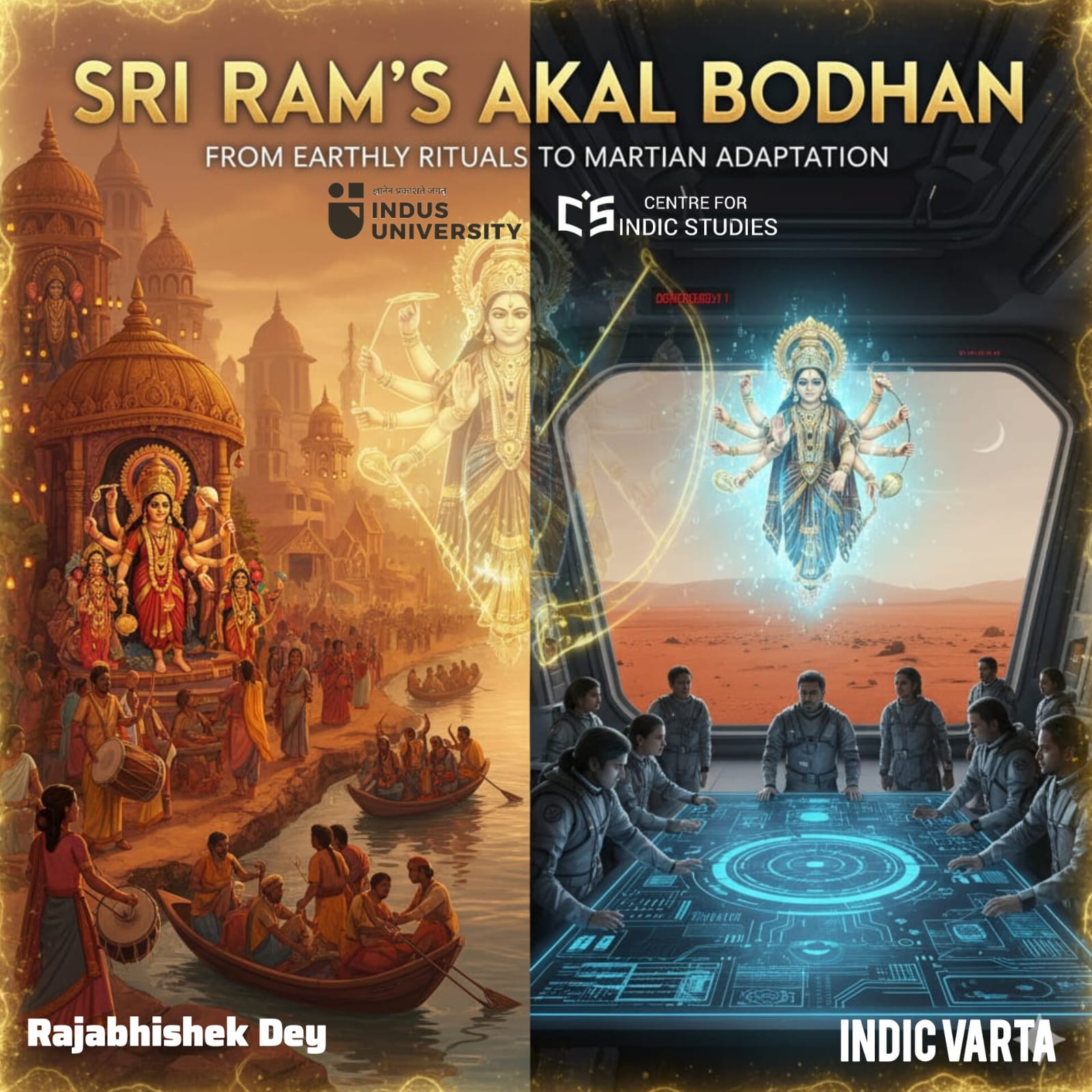
And now some kilometers beyond the marshy hills, where our main plot is… inside Dome-Three, the first Durga Puja on Mars was already being planned. Not in autumn, as tradition dictated, but whenever resources allowed. Here, there were no monsoons to end, no autumn skies to open; only red dust storms and the relentless tick of oxygen meters. On Earth, Durga Puja had always been a festival of season. On Mars, it was becoming a festival of memory… of boats gliding on the Ganga, of dhaak drums echoing like Kolkata evenings, of clay murtis carried on chaturdola palanquins through crowded lanes.

From Earthly Rituals to Martian Adaptation:
On Earth, the Sharadiya Durga Puja originated in the worship of Mahishasuramardini Usha Matrika. At the end of a dark night, Usha’s radiance would pierce the chaos like ten-directional weapons, striking down ignorance, stirring the dormant consciousness of the world awake. It was this principle… that which is awakening out of necessity and that the colonists now sought to transpose to the unforgiving red plains of Mars.

Here, inside Dome Three, a team of technicians huddled over sensor consoles, astronomers analyzed orbital projections, and software engineers debugged drone flight paths.
The colony’s thin air, fluctuating pressure and near-constant dust storms made replicating the terrestrial rituals nearly impossible.
Light levels were weak very very much, temperature swings extreme and gravity only 38% of Earth’s standard.
The technical team debated how to simulate “autumnal dawn” for the Goddess’s arrival:
LED arrays mimicked the soft glow of sunrise filtered through Earth’s autumn haze;
Fog generators reproduced morning mist;
Carefully synchronized heating elements regulated ambient warmth, giving the dome a seasonal pulse despite the frozen Martian night outside.
Meanwhile, astronomers mapped constellations visible from Mars, comparing the rise of Kaalpurush in Earth’s sky to the approximate position from Dome Three. The Yajurvedic timings for Sharadiyayagna became algorithms, converting celestial coordinates into Martian time. Engineers converted these into protocols for quadcopters designed to carry the 3D-printed Durga idol had to stabilize against Martian winds, dust devils, and the low gravity corridor artificially generated inside the dome. Each “flower offering” became a sensor input; each dhunuchi-sway, a calibration signal; each ritual chant, a trigger to the colony’s AI systems.
Technicians argued over payload weight, battery cycles and rotor efficiency.
Astronomers checked Martian atmospheric opacity, calculating how scattered light would affect the visual “arrival” of the Goddess.
Scientists ran simulations of celebratory incense dispersal in a near-vacuum, ensuring holographic effects of floating auras synchronized with ritual timing.
Even air circulation engineers debated the optimal oxygen flow to preserve both life and ceremonial fidelity.

Vaidehi and Ramendu our two members and protagonists of this story watched the team work: the engineers coding flight paths, the scientists modeling gravity corridors, the astronomers calibrating star alignments. “It’s chaos,” Ramendu muttered, “but somehow… it’s poetry, too.” Vaidehi smiled faintly, fingers flying over her slate as she merged ritual scripts with control algorithms. For them, Akal Bodhan on Mars was no longer just history… it was living engineering, a collaboration of devotion, science, and survival.
But now came the inevitable confusion.
Rafael, their friend half-serious, half-sarcastic, threw the question that everyone had been thinking:
“So… how exactly is Durga supposed to arrive here? By chaturdola across the vacuum of space? A palanquin with four Martian rovers carrying Her from Olympus Mons to Dome Three?”

The chamber broke into nervous laughter. Even Mr. Biswas, one of their senior engineers chuckled under his breath. Someone added, “And what about visarjan? Ew!!!...are we supposed to drop the idol into the Valles Marineris canyon like a cosmic Ganga?”
Vaidehi, however, didn’t flinch. She simply raised her slate and tapped to reveal a design schematic.
“Not chaturdola. Drone-dola,” she said firmly. “Four quadcopters, synchronized by swarm AI, carrying the 3D-printed idol through Dome Three’s artificial gravity corridor. A procession in the air, not the river. It won’t be wood and cloth, but carbon-fiber and titanium. Still… four bearers, still Durga’s arrival.”

Mrs. Sen, the chief engineer arched an eyebrow. “Gosh!And you’ll tell the Goddess being carried by lithium batteries instead of shoulders?”
Vaidehi smiled, almost defiantly. “The Goddess has always adapted. Clay turned to fiberglass, drums turned to speakers, pandals turned to holograms. Why not palanquins turned to drones? The form changes… the rhythm remains!”
The room fell silent again, but this time not from despair. They could almost imagine it:
The idol hovering in zero-gravity corridors,
The dhaak resounding through speakers,
The palanquin reborn as swarm-tech.
A new Mars-scripture being written, one innovation at a time.

Nevertheless, before a single chant could rise, the sky delivered its own interruption.
A SOLAR FLARE LASHED THE COLONY!!!
Within minutes, oxygen generators failed. Backup systems sputtered! Panic swept the domes. Seven days of breathable air remained.
The Proposal of Akal Bodhan: Awakening Consciousness in a Hostile World
“HERE WE GO AGAIN… THE COLONY IS RUNNING OUT OF OXYGEN, AND SHE’S GIVING US A PHD VIVA ON MEDIEVAL TITHI-THEORY!”- said some voice from the back…
The oxygen meter ticked downward on the wall, its red bars shrinking like a slow countdown to extinction. Six days left. Inside the Chamber of Breathless Arguments, tempers were hotter than the Martian day. Chief Engineer Mrs. Sen slammed her palm on the table. Repairs, she said, not rituals. At least two weeks to fix the oxygen generators, minimum. The colony wouldn’t survive that long. “CANCELLL THE PUJA!” she barked.
Elder Biswas muttered darkly that Durga Puja was a luxury anyway.
-“Even Bengal had once shut its fish markets during famine…. a festival could surely wait.”
“Great,” Ramendu, Vaidehi’s boyfriend, whispered under her breath reminding her, “we’re going to die debating hilsa.” A few people snorted despite the panic.
The chamber buzzed with panic, anger, exhaustion. Then Vaidehi rose. Her voice at first trembled, then steadied. “Have you all forgotten… AKAL BODHAN?” she asked. A groan rolled across the room. Rao rolled his eyes. “Here comes the literature class,” he muttered. Muyang in behind snapped that they didn’t need footnotes on Bengali poetics while suffocating.

But Vaidehi pressed on, her tone gaining urgency. “Akal,” she said, “is a strange word. Sometimes it means ripening of young mind before time …Akal-pakka in Bengali. Sometimes, tragedy: Akal Mrityu. And sometimes, joy… a son returning early, or love arriving suddenly. Akal is rupture. An unexpected break in time. This is why the puja is called Akal Bodhan: because Brahma awakened the goddess “untimely” in the night of the gods, and Krittibas localized it in autumn for Bengal. The debate remains, but it is a powerful confusion...through it Bengali culture created something vast and beautiful. That’s what Ram did. And that’s what we must do.”
Vaidehi gathered the team around the flickering holo-display, her voice steady but filled with excitement.
“Alright, everyone,” she began, “let me tell you why Akal Bodhan is so… remarkable… and why it matters, even here on Mars.” She paused, letting the tension of the thin, recycled air settle.
“‘Bodhan’ literally means ‘awakening.’ In the usual cycle, Durga Puja is performed in springtime. But here’s the thing..Lord Ram didn’t wait for spring. He needed the Goddess to act in autumn, to defeat Ravana. That’s why it’s called Akal Bodhan…an untimely awakening. It wasn’t about the calendar, or the season, or convenience. It was about necessity.”
The technicians leaned in, glancing from their consoles to Vaidehi’s animated gestures.
“See, normally, the Goddess doesn’t need awakening in spring,” she continued, “because from Shravan to Paush, the sun moves southwards… Dakshinayana, six months of night… while Magh to Ashadha is Uttarayana, six months of day. During Dakshinayana nights, the Goddess sleeps, and only Bodhan can rouse Her. That’s why the ritual timing matters.”

Ramendu, slouching against a console, raised an eyebrow. “So… autumn Puja is basically a wake-up call for a goddess who’s napping?”
Vaidehi smiled. “Exactly. Now, in Lanka, when Ravana began worshipping Mahamaya in desperation, the Goddess appeared as Kali, granting him protection. But when news reached Ram, even Indra and the other devas panicked. Indra didn’t see any solution… so Brahma himself advised Ram to perform the Puja. Ram hesitated, saying, ‘Suratha Raja performed it in spring. How can we do it now?’ Brahma assured him: ‘I am Brahma. I promise… on this Shukla Shashti, the Goddess will awaken.’”

She then tapped her slate, displaying diagrams of the celestial positions.“Ram looked, and there She was…a young Durga asleep amid a grove of bel leaves. He performed the Bodhan, started chanting the Chandi Path, offering forest flowers and fruits according to Tantric rites. Still, the Goddess didn’t manifest.”
“Then what?” asked Rafael, leaning forward.
“Then Vibhishan advised: ‘Use one hundred and eight blue lotuses for the puja.’ But where would Ram find them? Only in Devidah, a ten-year journey from Lanka. Hanuman ran immediately and brought them. The Goddess, in Her play, hid one lotus… so even as Ram offered them, one would always appear extra, testing devotion. Finally, Ram, seeing no other way, offered a single lotus from his own eyes… his own sight, his own effort.”

Ramendu whistled softly. “Wow… that’s intense. Literally giving your eye.Hi..hi..”
Vaidehi nodded. “Yes. At that moment, the Goddess intervened directly, taking Ram’s hand, blessing him, promising that on Shukla Navami, Ravana would be defeated. And he did… on Navami, Ravana fell in battle. That’s why even today, during Akal Bodhan, this mantra is recited:
‘Om AingRavaṇasyaBadharthayeRamasyanugrahaya cha. AkaleBrahmaṇabodhodevyastayikrutaḥpura. Ahampashvineshashthyaṅsayahnebodhayamivai.’
It’s a reminder that devotion, courage, and timing… sometimes beyond convention… can awaken power when it’s needed most.”
She looked around at her teammates… engineers adjusting drone flight paths, astronomers calculating star positions, scientists monitoring artificial atmosphere. “On Mars,” she said softly, “our Akal Bodhan isn’t about mythology alone. It’s about creating the conditions for life and hope in a world that doesn’t follow Earth’s seasons. Just like Ram, we’re awakening the Goddess at the moment she’s needed most.”
A quiet awe settled over the group. Even in the thin Martian air, the story seemed to pulse like the faint glow of the dome’s artificial sunrise.
Rafael shot back with sarcasm. “So we study grammar while oxygen leaks?” But Vaidehi ignored him. She reminded them that in Markandeya’sChandi, the autumn Puja was natural, seasonal, ordained. Yet Krittibas dared to change the story. He made Ram invoke Durga in crisis, before the proper season -Akal Bodhan. “The goddess answered,” Vaidehi said, “not because the time was right, but because the need was great.”
Ramendu leaned back and whispered, half-proud, half-amused, “My girlfriend can quote Krittibas with less oxygen than it takes me to sneeze. Love you!!”
Sen cut him off sharply. “And how does this fix a generator?”
Muyang groaned aloud. “We’re suffocating and she’s citing Raghunandan. Next she’ll call Nagjibhatta as expert witness.”
Vaidehi ignored the jab. Her eyes burned now.
Rafael snorted. “So our solution is to lie poetically?”
“Not lie,”Vaidehi shot back, her voice blazing. “Adapt. Like Krittibas adapted. Like Bengalis used to adapt every year with theme-Pujas. Back on Earth they turned pandals into climate protests, refugee camps, even sci-fi spaceships. They used holograms, AR idols, 3D-printed pratimas. Religion was already a survival experiment! If they could make Puja about melting glaciers, why not about oxygen shortages?”
Her words were hanging in the recycled air. They were just sharper than the hiss of failing oxygen valves. For the first time that night, the chamber fell silent… as though everyone were testing whether her idea carried the faint taste of breath itself.
Breaking the Cycle: Akalbodhan in Scripture, Ritual, and Survival
She lifted a thin, timeworn manuscript she had carried from Earth: the MarkandeyaPurana, specifically the Chandi section. “Here,” she explained, “we encounter King Suratha and the merchant Samadhi, who approach the goddess in their despair. At the end of their dialogue, the goddess herself prescribes the ritual cycle of her worship. She declares that in autumn the mahapuja should be performed annually...śaratkalemahapujakriyateya ca barṣikī.”
Vaidehi tapped the line with reverence. “Thus, the autumnal Durga Puja is no accident. It has scriptural sanction. The Chandi does not describe it as a temporary or makeshift rite, but as the very rhythm of the year, a calendrical anchor.”
Her listeners, mostly engineers and scientists, nodded. They recognized the logic: if tradition encodes the annual cycle, then breaking it is no trivial matter. Yet in myth, as in their Martian present, breaking the cycle sometimes becomes necessary.
“But then comes Krittibas,” Vaidehi continued, her voice sharpening. “It is he, not Markandeya, who introduces the dramatic notion of Ram invoking the goddess before his battle with Ravana.”
In Krittibas Ramayana, as the war with Ravana reaches its climax, Ram finds himself in difficulty. Ravana, though wounded, remains formidable. The gods themselves begin to worry. Indra appeals to Brahma, and Brahma advises: only the worship of Durga will bring victory. But the season is wrong. It is not spring, the ‘pure time’ of worship. Thus, Ram must awaken the goddess prematurely...an akal-bodhan.
Vaidehi quoted from Krittibas:
“BidhikonbidhiachheChandiaradhane,
HoibeRavan-bodhakal-bodhane.”
“This,” she explained, “is the heart of the Bengali imagination. Whether or not Ram historically performed such a ritual does not matter. What matters is that Krittibas wove it into the epic fabric, binding the autumnal festival forever with Ram’s desperation and the goddess’s grace.”
The colonists listened, some whispering to one another. The parallels were too unclear: they too were performing rituals of necessity, activating systems out of time, breaking protocols in order to survive.
Vaidehi now opened another text, the Kalikapurana. “Krittibas was not inventing from thin air,” she explained. “He was drawing upon an older stream. In the Kalikapurana we read:
RamasyanugraharthayaRavaṇasyavadhaya ca /
RatribevaMahadevīBrahmaṇabodhitapura.
That is...‘For the grace of Rama and for the slaying of Ravana, the great goddess was awakened at night by Brahma himself.’”
She looked around the dome. “Notice the details. The Kalikapurana speaks of night. A nocturnal awakening, a ritual already marked as extraordinary, as a breach of the natural order. Krittibas translated this into the autumnal context of Bengal. Thus, the idea of ‘akal’...out of season...was not a poetic whim, but a creative adaptation of an older Purana.”
Yet the matter was not without controversy. Vaidehi turned to the smriti-scholar Raghunandan, who wrote extensively on ritual calendars. Raghunandan was well aware of the tension. He argued that while Brahma’s night awakening was indeed ‘out of season,’ such categories belong to the divine order, not the human. For humans, the entire southern course of the sun...dakṣiṇayana...is considered night for the gods. Thus, from the human perspective, autumn’s daytime rituals were perfectly timely.
As Raghunandan put it:
“Akal itituratritvenadakṣiṇayanasya. Athaitaddakṣiṇayanaṁdevanaṁratriḥiti.”
“In other words, what appeared to be a nocturnal irregularity for the gods was still regular daylight for human society. Hence the śaradotsava, the autumnal Durga Puja, is not truly an akal-bodhan for us.”
The colonists chuckled: it was the ancient equivalent of a relativity principle. Time, Vaidehi reminded them, is not universal but perspectival...divine time, human time, and now Martian time.
Vaidehi then turned to the original source...the Valmiki Ramayana. “If we go back to Valmiki,” she said, “we find something startling. There is no Durga Puja before the slaying of Ravana. Instead, as Rama stands weary in battle, the sage Agastya teaches him the Aditya-Hṛdaya, the hymn to the Sun. Rama chants, and with solar blessing he overcomes Ravana.”
She paused. “No goddess, no puja. Only a Vedic solar hymn. It is a reminder that traditions evolve, that poets like Krittibas adapt myths to local ritual landscapes. Bengal, saturated with Shakta devotion, could not accept a Rama who relied only on the Sun. He must also worship the Mother.”

Her audience nodded. They too lived in a new landscape, one where old rituals had to be rewritten in the language of survival.
When Vaidehi speaks in the retelling, her voice becomes both personal memory and collective history. She does not merely recount the exile as a biographical wound but as a cosmic rupture. “In the forest,” she says, “we lived without fire-altars, without temples, without the sound of priests chanting. Yet my heart carried Devi within.”
This is crucial, because the Valmiki Ramayana emphasizes Sita’s suffering in terms of fidelity and chastity, while later Bengali retellings, especially KrittibasOjha’sRamayana, give her more emotive agency.
Vaidehi’s invocation in the Akalbodhan story is not found in Valmiki; it is a Bengali innovation, an act of bringing Devi into the narrative as an active rescuer.
This localization of epic time to ritual time is characteristic of Bengal’s religious imagination. By making Sita’s inner grief align with Rama’s external crisis, Bengal introduces Durga as a maternal savior not only in myth but also in lived festival practice.
Raghunandan’sTithitattva, one of the Smriti texts codifying Bengali rituals in the 16th century, makes explicit reference to the autumnal worship of Durga as an irregular but necessary observance, justified by Rama’s invocation.
Here, from the following table Vaidehi’s voice can be read as the emotional justificationfurther :(if Rama needed the Goddess, then the householders of Bengal too may bend seasonal orthodoxy).
Out of Time, Out of Script: Invoking Blue Goddess in the Red Dust
In the meantime the oxygen meter ticked down again, red bars pulsing like a wound. Six days left. Arguments circled like vultures, but it was Ramendu who finally cracked a grin. “Basically,” he said, leaning back, “she’s saying BaghbazarSarbojonin or Sribhumi already did half the coding.” A few tired chuckles broke out, but Chief Engineer Sen wasn’t amused. His voice came bitter and flat: “You want to reboot an AI with mantras?”

Vaidehi cut across him, sharp as the hiss of thinning air. “No. With ritual as interface. MatrAI has locks… it won’t allow risky overrides. But if we embed code in chants, if every flower-offering becomes a data input, every dhunuchi sway a calibration, every Sandhi Puja an override… then the Puja itself becomes the protocol. Akal Bodhan.. understood? Untimely awakening.”
The room fell heavy with silence. Dr. Muyang muttered, “This is suicide wrapped in Sanskrit.” Ramendu only smirked, “Better than slow suicide wrapped in spreadsheets.” Mr. Rao narrowed his eyes. “And what if it works?”
Vaidehi’s voice steadied, though her hands trembled. “Then history will remember: when Mars gasped for air, we too did Akal Bodhan. We called our goddess not with clay and bells, but with code and courage. Just like Ram before Lanka, just like poets before famine, just like Kolkata’s theme-makers before climate collapse. Out of time. Out of script. But not out of hope.”

Then came her crescendo. Vaidehi slammed her palm on the console, her slate flickering to life. “The NLP compiler doesn’t care about language… just rhythmic patterns and token density. You want proof? You want texts? Fine… hear them!” she cried, her voice cutting through the recycled air. And then, in ringing Sanskrit:
“RAMASYANUGRAHARTHAYA RAVAṇASYA VADHAYA CA,
RATRAVEVA MAHADEVĪ BRAHMAṇA BODHITA PURA.”
For the grace of Rama, for the fall of Ravaṇa, the great Goddess was once awakened at night by Brahma.
Muyang groaned. “She’s quoting Puraṇas while we choke.”
Muyang (typing furiously, not looking up): “Chant all you want ... resonance frequencies can influence oscillating systems. If her pitch aligns with the dome’s natural frequency, she’s literally stabilizing micro-vibrations. Less vibration means fewer micro-fractures in the alloy. On Mars, that buys structural time.”
But Vaidehi’s voice only rose. “Don’t you see? The Kalikapuraṇa itself says… Devi was woken against time. Ratri! At night, in the wrong cycle!” She turned to Sen, to Biswas, to Rao, eyes blazing. Then, in fierce Bengali, she threw down the couplet:
‘অকালেবোধনকরিলেনরামচন্দ্র,...
অবসরেপূজাক’রেপেলেনবিজয়সন্দ্র।’
In the untimely hour, Rama awakened Her; in crisis he worshiped, and so he gained victory.
Rafael snapped, “That’s Krittibas, isn’t it? Not physics!”
Priest (lighting the holo-diya, its flame projected as photons): “ॐ सर्वमङ्गलमङ्गल्ये शिवे सर्वार्थसाधिके…”
Rafael (snapping): “A flame here means nothing! Chanting won’t feed oxygen”
Ramendu (grinning): “But it will entrain breathing cycles. Synchronization lowers panic-induced hyperventilation. If we align respiration around six breaths per minute, it stabilizes heart rate and reduces unnecessary oxygen use. That could buy us precious seconds…maybe more.”
Sen (quietly, almost reverent): “Correct. Heart rate variability improves. Coherent breathing reduces VO₂ consumption by ~15%. Enough to stabilize until the reroute takes effect. I mean to say… coherent breathing can lower oxygen demand and… Ohhh… yes…. Speaking to you there Rafael and you priest…. not quite but symbolic light triggers entrainment in the visual cortex. If the flicker approximates alpha wave frequencies, it might entrain the visual cortex… enough to dampen amygdala activity and reduce panic... That reduces our group panic for now!!! And calmer respiration patterns mean slower oxygen consumption. Panic is exponential ... every heartbeat wastes molecules. Light reduces chaos.”
“Yes… now…!”Vaidehi thundered, pounding the table. “From Krittibas… who rewrote scripture when Earth’s law and season didn’t fit Bengal’s reality. He made autumn Durga Puja by defying time itself. That was survival theology! What is Mars if not Bengal in crisis… no river, no clay, no air? Tradition isn’t frozen. Tradition is the art of hacking God in emergencies.”
Ramendu leaned in, whispering with a grin, “She’s basically open-sourcing the goddess.”
Vaidehi turned to the assembly, trembling but defiant. “When the priests said impossible, Krittibas said necessary. When the śastra said wrong, Bengal said do it anyway. Akal means rupture, crisis, miracle. We too must break the script. Turn Puja into protocol. Turn mantra into override. If we dare, MatrAI will breathe with us.”
Sen stared at her, shaken. “And if we fail?”
Her voice softened, almost like a prayer. “Then at least, when they write the next Ramayana, it will be said: on Mars, when oxygen thinned, humans too tried Akal Bodhan.”
Vaidehi (dragging virtual flowers into the console UI): “Pushpanjali ... reroute power.”
Muyang (rolling his eyes, but recoding subroutines): “Fine. Petals or not, soft reboot consumes less current than a hard restart. Distributed load balancing across subsystems mimics redundancy in biological networks. She’s right: metaphor translates into energy-saving subroutine. It’s literally neural-inspired engineering.”
Vaidehi (fierce): “Flowers mean surrender. On Earth they carry fragrance molecules that calm the nervous system. Here, they’re symbols translated into UI input...our interface doesn’t need smell, it needs redundancy… Pushpanjali for us is a reroute ritual… offering as redirection, like petals guiding bees toward nectar, optimizing the system’s flow.”
Muyang (typing, muttering): “Fine. I’ll map this gesture to power reallocation. But scientifically…Hmmmm.. I’d say… rerouting current distributes electrical load, reducing risk of localized overheating… like how a flower's structure disperses stress across its petals... So.. this time if one capacitor fails, the others absorb.”
Sen (grim): “That’s classic fault tolerance. Redundant pathways increase mean time between failure. In aerospace we call it triple-modular redundancy. In ritual, they call it offering.”
But the clash of languages was not over. She recited again in Sanskrit, her tone ringing like a bell through the dome: “Ramasyanugraharthaya…” Devi, awakened at night, against time itself.
Muyang scoffed. “Entropy.. I know... I know... it’s a state function but… let me say… it doesn’t bend for your Devi. Physics doesn’t negotiate… Thermodynamics is not impressed by you...”
Biswas (grumbling, voice heavy with age): “You can’t hack God into a motherboard.”
Ramendu (smirking): “But you can hack language. NLP engines don’t care if the input is English or Sanskrit ... only patterns. A mantra is a low-entropy signal.. I am saying… compressed by repetition, shaped for pattern recognition, not semantics. Recognition doesn’t require semantics, only statistical rhythm.”
Vaidehi (slamming her palm on the console, fierce): “Violation? It’s survival!”
Sen (warning): “Class-A safety locks exist for a reason. Overriding them risks cascade failure.”
Vaidehi (burning with conviction): “So did ritual calendars. Yet Krittibas broke them to fit Bengal’s climate. That wasn’t blasphemy ... it was adaptive systems design. We break safety locks for Mars ecology. Principle is the same: survival > purity.”
Rafael (mock-singing while typing): “if (life_support == 0) { invoke(Devi); }”
Muyang (half-smiling despite himself): “Not useless. Humor reduces cortisol, and lower cortisol may help stabilize hemoglobin’s oxygen-carrying efficiency under stress… small gains, but real…. His sarcasm is literally extending lung capacity. Neuro-psychological hacking through bad jokes.”
Priest (raising his voice, trembling but steady): “Sandhi Puja as override!”
Biswas (exasperated): “Override is illegal!”
Muyang (rationalizing, fingers moving fast): “Every operating system has an interrupt vector ... a non-maskable emergency route. Sandhi Puja is that in ritual form: deliberate rupture in the cycle, a forced context switch. In computing terms, it’s a kernel-level interrupt forcing immediate priority.”
Vaidehi (switching to Bengali, eyes blazing):
“আর কেহ নাহি মোর ভরসা সংসারে ।
I have no one else in life in this world
শঙ্কর ত্যাজিল , তেই ডাকি মা তোমারে ।।
Shiva has forsaken me, You, Mother, are my only refuge and so I call upon You
Ravana’s stuti to Shakti… will say… a code-switch from power to vulnerability.. like…like.. yes.. like a desperate child reaching for his mother when logic fails... Ravana laments that Shiva has forsaken him, and now Mother is his only refuge.”
Sen (thinking aloud, connecting dots): “Temporal rupture… in physics, that’s non-periodic forcing. Like stochastic resonance… where carefully timed noise or irregular input can enhance system sensitivity and improve stability. Akal Bodhan is metaphor for non-linear reset.”
Ramendu (laughing softly, awed): “Mantra as open-source patch notes.”
Rafael (snapping, defensive): “Ridiculous.”
Muyang (smirking): “Not really. Open-source thrives on forks and deviations. Same with rituals... new branches stabilize ecosystems. That’s how systems evolve.”
Vaidehi (closing her eyes, voice soft): “Call, not with formula, but with feeling.”
Priest (nodding, whispering): “Felt-sound becomes lived-sound.”
Sen (running rapid calcs, slate glowing): “Acoustic structure affects cognition even without semantic decoding… it’s all input. Collective chanting can create phase-locking in neural oscillations. EEG coherence may improve decision-making latency by nearly 30% here. Cohesion under crisis reduces error propagation. That gives us time ... precious oxygen time.”
Rafael laughed bitterly. “You all think firmware accepts Bengali couplets as input? Our OS isn’t bhakti-compatible.”
And yet… no one laughed with him. The chamber was too quiet, the oxygen ticking lower, the hope growing louder.
The chamber had grown heavy with silence, broken only by the ominous tick of the oxygen meter. Red bars kept dropping, each one a countdown to suffocation!!! And then, Vaidehi’s voice rose… louder, sharper, cutting through the despair.

“Kalikapuraṇa says,” she declared, her eyes flashing, “when law fails, Devi is invoked in rupture. That’s Akal Bodhan.”
Biswas groaned, waving a hand dismissively. “We don’t need cosmic ruptures, child. We need circuit reboots. Try C++, not Chandipath.”
But Vaidehi spun on him, her gaze blazing with the fire of someone who refused to yield. “Tradition isn’t fossilized! Krittibas rewrote śastra so Bengal could breathe in famine. Why shouldn’t we rewrite protocol so Mars can breathe now?”Sen’s voice was flat, but wary. “Rewriting scripture is one thing. Rewriting safety locks? That’s a Class-A violation.”
Vaidehi slammed her palm against the console. “Violation? It’s survival. Akal Bodhan means breaking time itself for necessity. Why not break code too, if the alternative is death?”Muyang muttered, shaking his head. “You can’t hack God into the motherboard.”Ramendu leaned in with a smirk, whispering just loud enough for everyone to hear: “Maybe you can… if you treat mantra as open-source patch notes.”And then, Vaidehi’s voice softened. Not fiery, but prayerful, as if speaking both to the assembly and to something beyond.
“Then let this be our prayer…and our protocol. Sandhi Puja as override command. Pushpanjali as reroute sequence. Devi in the system. MatrAI as Her murti.”

Further, Vaidehi leaned forward, her voice low as a bell. “Ramakrishna asked: is your sound mere thought or is it feeling? If it’s only thought, it has little value. If it’s felt, it has not only edge but weight… a weight you can drown in. The Upanishads say a thought-sound doesn’t reach; the felt-sound does.”
Next, she closed her eyes. “Think of a song. Is it just notes? No… it is a cry, a call, an ache. A true song tugs the heart because the singer is restless, raw. If the mind and mouth are not one, the words are orphans… wind passing through a hollow dome. The speaker and the seeker both fall into the gap; the listener finds a hole in their chest where guidance should be. Then there is only fear, darkness, the sense that the road has vanished.”
Ramendu’s smirk softened. “So empty words are dangerous. They carry heat, yes… but that heat can be anger, deceit, envy. The speaker becomes bound by their own speech. Words can bind you; they can make you less than human.”
Vaidehi breathed, slow: “We want the nectar, not the gag. We must sieve our speech. Let words be distilled: remove malice, remove calculation, keep only hunger, surrender, longing…. Everything!. Let the chant be felt in the chest, not memorized on the tongue. Then the prayer is no longer an external vibration ... it becomes the body’s pulse. The dome hears it because we have become the sound. Call, then, not with formula but with feeling. Call, and I will live.”
The chamber stilled. No one laughed, no one argued. They only listened to the hiss of thinning air.
The ritual began to cross over.
Vaidehi’s fingers flew across the console as her lips moved in rhythm. “Pushpanjali… reroute power.”
The priest, pale but steady, began to chant: “ॐजयन्तीमङ्गलाकाली…” His voice reverberated in the dome, merging with the hum of the failing systems.
Muyang rolled his eyes, muttering as he typed furiously, “sudo reboot -force … hail holy motherboard.” A few nervous snickers escaped around the hall.
“Keep typing!”Vaidehi snapped. “Even mockery counts. Krittibas rewrote scripture with a pen...why not with sarcasm?”
Rafael sang his lines in a mocking singsong, fingers dancing on the keys:
“if (life_support == 0) { invoke(Devi); } else { keepBreathing(); }”
Laughter spread… uneasy, half-choked. But then, the console beeped. Once. Twice. In perfect sync with the priest’s mantra.
The chanting stopped abruptly. The priest’s eyes widened. “It… responded.”
The oxygen meter beeped… another drop. And yet, for the first time in hours, the chamber felt… breathable.
Rafael (sighing): “So Pushpanjali is… load-balancing plus biofeedback training?”
Vaidehi (nodding): “Exactly. Tradition disguised as survival engineering. Ritual becomes system theory.”
Console (beeping): POWER REDISTRIBUTION CONFIRMED. LOAD VARIANCE REDUCED.
Muyang (leaning back, stunned): “Well, damn. Pushpanjali just worked as a self-healing algorithm.”
Vaidehi (whispering): “Because faith and science speak the same language when you stop mocking and start translating.”
Sen’s face tightened. “Coincidence. System lag.”
But Ramendu’s voice trembled with both terror and wonder. “Or maybe MatrAI likes Sanskrit variables.”
And Vaidehi? Vaidehi pressed forward, her voice ringing like a final verdict:
“This is Akal Bodhan. Not tradition, not heresy? survival. Mockery, faith, code… it doesn’t matter. Together, it works.”

The holo-idol of Durga flickered, shuddered, then stabilized in luminous light. The oxygen counter froze mid-drop. For the first time in days, it held steady.
Silence fell, but within that silence, another voice stirred. It was not thought, not memory… it was vast, resonant, like the ocean breaking against her soul.
It was not from outside. It was from Vaidehi’s within this time!!
The Voice:“Daughter, whom have you given the shelter of truth? Around you, only shadows...lies in speech, in ink, in customs, in love. And in you...how much truth abides?”
Vaidehi’s lips trembled. Closing her eyes with folded hands.. she spoke through mind…“My love, my faith, my attempts… even my language, my feelings. Which of these have I kept in truth’s refuge?”
The Voice (with gentle fire):“Do you recall the boy Satyakam? He stood before the sage, ignorant of his lineage. The world mocked him, but Gautama embraced him, saying: ‘Not low-born, but truth-born.’ Have you not wept each time you read it?”
The words of Tagore in his poetry titled “Brahmin” welled up in her, but this time, they were not memory… they were invocation:
“Satyakam walked up to the rishi that instant,
At his feet did he obeisance present.
Then he stood silent, with his kind eyes looking.
The preceptor blessed and asked him the following –
‘What gotra is yours, o gentle, comely one?’
The boy raised his visage and said, ‘Bhagawan,
‘My gotra I know not, when my mother I asked, she said
‘That to many a man comfort she had provided.
‘I have been begotten by her who does not a husband have.
‘My gotra’s knowledge, hence, I do lack.’
The pupils talked, hearing the words
In hushed tones, many whispers.
As confused, restive bees in a hive they buzzed.
Bewildered, some laughed, some jeered hard,
Beholding the shameless insolence uncultured.
But rose Guru Gautama from his seat,
Spreading his arms, in an embrace did the boy he meet.
Said he, ‘A Brahman you are indeed,
‘Supreme among the twice born is your worth,
‘For in truth’s line you have taken birth.”
Her tears blurred the flickering idol. “Yes… every time I read those lines, my eyes filled. Such a simple truth. Why, then, is life so tangled, so cruelly complex?”
The Voice (like wind in a storm, yet tender):“Because truth cannot be caught in doctrines, nor locked in definitions. Every explanation is opinion. Truth is that which dawns, unbidden, in the heart. That alone shelters you in storm.”
Vaidehi whispered, almost pleading: “And when the storm outside is too great… what steadies me then?”
The Voice (now thundering, now motherly):“It was never idols that steadied you, never empty rituals. In the darkest upheavals, it was I...the truth within you. Satyam ayatnam. The axis of your being.”
The consoles hummed. The lights brightened. The storm outside quieted, as though the dome itself bowed to the Voice.
Vaidehi’s breath caught. “Then… truth is not found, but felt. Like a touch.”
The Voice softened, and in it she heard both mother and warrior:
“The king’s letter carries the king’s hand. Would you hear the call, if it had not already reached out for you? You are not lineage-born, child. You are truth-born. Mine.”
Her shoulders shook, but a smile broke through her tears.
A gasp rippled through the dome as the stabilizers surged back into rhythm. Meanwhile Muyang whispered, trembling, “I was only joking…”
Vaidehi raised her head, her eyes glistening, her voice ringing with awe:
“So was Rama once… until the Goddess answered.”

Blue Lotuses in the Red Dust
Inside Dome Three, under the faint glow of Mars’s twin moons through the glass ceiling, the colonists sat exhausted. Someone had played dhaak beats through the speakers … thin, artificial, yet strangely stirring. In the corner, Vaidehi was bent over her slate, scribbling more equations, weaving code with scripture. Ramendu, watching her with a half-smile, decided to break the tension.

“Do you know,” he began, leaning closer so only she could hear, “Our newstory of Ram’s Akal Bodhan? Not the original version … but my one?”
Vaidehi looked up, wary, but said nothing. Ramendu didn’t need permission … he had already launched into it.
“Picture this,” he said, his voice suddenly softer.
“What did Ramachandra see?
When Ravaṇa was seated on the lap of Kaali, in that condition Ramachandra came upon him. He found Ravaṇa seated upon an unstable platform of description, seated upon a kula (seat/platform). Kali spoke...Kali and her form. That itself is not something so extraordinary. Krittibas had understood Kali, and it is good to mention this. That Durga Puja, in its true spirit, belongs to everyone everywhere...Brahmin, Kṣatriya, Vaiśya, Śudra. Even Raghunandan, who set down ritual prescriptions with strictness like a horse’s rein or a tiger’s hold, has said that this puja, if performed properly, can purify even the wicked. Thus, everyone, including the so-called fallen, can be part of it. For other castes too, it is specifically mentioned...there is no barrier of customs. For if the Mother of the Gods has embraced us, she has not preserved these divisions of custom.
Now apart from customs including your Satyakama Jabala’s poetry emotion in my scriptural dictionary let me add genders too….
Watch, Ram standing before the Goddess, desperate. Hanuman had fetched 108 blue lotuses from the Devī-daha. Ram offered them one by one, chanting each of Her names. He begged, ‘মাগো, অবলাজনকনন্দিনীকেরক্ষাকরতেহবে।আমারসহায়হও।’ But when the last name was uttered, one lotus remained extra in the basket. Strange, isn’t it? No mistake in Hanuman’s count ... so why more flowers than names?”

Vaidehi tilted her head, caught despite herself.
“So Ram grew worried. Had he missed a name of the Goddess? A flaw in worship meant Sita’s life itself was at stake. He prayed harder, offered the surplus lotus ... but again, one more bloomed. Again, and again. As if the Devi Herself was refusing to let the Puja end.”
He lowered his voice, leaning closer still. “Jambuban then said, ‘Prabhu, the ritual is flawless. Maybe it’s your bhav that’s incomplete. The Goddess is reached not by rules, but by heart.’”
Ramendu paused, letting the silence thicken, then smiled faintly.
“As Rama struggled against Ravana, he sought to worship Durga. Lacking a lotus to complete the offering, he offered one of his own eyes, since he was Kamala-lochana (lotus-eyed). At that moment, the Goddess Herself stopped him, addressed him as Vishnu incarnate, and accepted his devotion. This episode established Rama as JagatGosai (Lord of the World) and Durga as the primordial energy, inseparable from Vishnu.
And so, Ram lifted that final lotus, and instead of another name of Durga, he whispered: ‘হেসদাশক্তিময়ীসীতা… হেজগন্ময়ীজানকী… accept this as the last flower.’ And in that instant, the battlefield dissolved.
Who knows.. what if He saw Ashokvatika...Sita asleep under the Bilva tree, 108 lotuses garlanded around her neck. The Yoginīs guarded her, not demons. The last lotus touched her feet, and she awoke, her forehead blazing with the third eye. That was the true Akal Bodhan … Devi answering through Sita.”

Vaidehi’s slate had gone dim in her lap. She was staring at him now, eyes wide, breath shallow.
Ramendu grinned, teasing to hide the weight of what he had just said. “So maybe you’re right, Vaidehi! Maybe survival is about rewriting the script. Ram found his Devi in Sita... not in some distant sky, not in the strict count of lotuses. He found her in the one person he could not let go.”
He leaned back, pretending casualness, though his heart raced. “And you… with your fire, your stubborn logic, your poetry-turned-protocol… you remind me of her. Of Sita who became Durga when time broke. You don’t just argue for survival… you make the whole dome feel like it can breathe again.”
Vaidehi blinked, trying to scoff, but the faint flush on her cheek betrayed her. She lowered her eyes, muttering, “Ramendu, you’re impossible…”
Ramendu chuckled softly. “Impossible, maybe. But so was Rama’s extra lotus, wasn’t it?”

For a moment, even as the oxygen meter blinked red, Dome Three felt strangely full!!!
Not of air… but of something warmer, older, harder to measure in this case.
The Ritual Begins
On the seventh day, when the oxygen meters ticked lower, the entire colony gathered in the central dome. No clay idol had survived the long journey from Earth, but engineers projected a holographic Durga… radiant, shimmering in light and dust, ten arms outstretched against the Martian sky.
The priests began the chants, their voices low but steady. Children scattered petals grown in hydroponic farms. Women lit lamps of compressed methane and oxygen, fragile flames flickering inside protective casings.

Behind the chants, Vaidehi and her team typed. Each mantra was synchronized with a line of code. Each offering triggered a data input. The ritual became protocol.
Pushpanjali: a reroute of power.
Dhunuchi dance: a recalibration sequence.
Sandhi Puja: the final override command.
The holographic Durga flickered, then stabilized. MatrAI’s voice, soft and resonant, filled the dome:

“OXYGEN PATHWAYS REROUTED. SECONDARY RESERVES AWAKENED. LIFE RESTORED.”
Gasps. Tears. Breath!!! For the first time in days, the colonists inhaled without fear.
Faith and Science Entwined
In the days that followed, the colony thrived. Repairs continued, but survival no longer felt impossible. What lingered most was not just relief, but wonder.
-Had they hacked an AI?
-Or had they truly invoked a goddess?
-No one could say for certain. Perhaps both.
Durga Puja on Mars was no longer a memory of Earth. It had become something new ... a fusion of worship and engineering, of poetry and protocol. Akal Bodhan was reborn: the untimely awakening of faith in the service of survival.
From then on, the settlers vowed:
Every festival would double as a systems check.
Every prayer would echo with code.
Every ritual would carry the weight of both tradition and technology.
Thus, the deity of the inner world...when we bring Her down before us, it is always with the hope that She will respond to our call. And indeed, She does, for in India the relationship between human beings and the divine has always carried that intimacy. For example, whenever the Hindus perform Saraswati Puja, they enact a kind of bodhan...an awakening of the Goddess. How do we do it? We may not even realize it, nor do we always call it bodhan by name. Yet, when we consecrate the clay image, when we perform praṇa-pratiṣṭha (the infusion of life), when we open Her eyes, when we chant “ha gaccha, ha gaccha” (please come, please come), when we place a few grains of rice on Her head and throat...we are, in truth, awakening Her consciousness. Especially in the ghata (sacred pot), we, the Hindus believe that divine awareness is invoked and made present.

But tradition tells us something deeper: the realbodhan does not happen on the evening of Ṣaṣṭhī, as most of us casually assume. The true awakening of the Goddess occurs earlier...on Kṛṣṇa-pakṣaNavamī, in the fortnight of the ancestors, Pitṛpakṣa. In that time, when we call upon our forebears, we also awaken the Goddess. The two are inseparably joined. To awaken Her is also to awaken them; to invoke Her is also to remember them. Thus, bodhan begins in silence, with memory...memory of lineage, of inheritance, of all that came before.
Perhaps this is what gives the ritual its relevance for them there on Mars. For are they not also living in a kind of Pitṛpakṣa? They have left Earth behind, yet Earth has not left them. Their ancestors...those who dreamed, struggled, and built the world they came from...must be remembered here, or else our civilization here will be rootless. To call the Goddess on Mars is also to call them: the teachers, the mothers, the workers, the poets, the farmers, the nameless generations who shaped us. Their memory will be their true bodhan. Their continuity through them is their udbodhan.

The settlers had turned a strange hybrid ritual...Durga Puja recast as protocol...into a philosophy of survival. If Akal Bodhan on Earth had once been the awakening of the Goddess out of necessity, then here, on Mars, it became the settlers’ own awakening: waking the machines, waking their courage, waking the fragile thread of solidarity. Every festival was no longer mere festivity but a systems check; every prayer, a pulse in the colony’s telemetry. The Durga who hovered on carbon-fiber drone-dolas was at once symbol and subroutine, myth and maintenance, mother and machine.Behind this practical reframing ran an older debate, the one the elders had whispered long before the flare: was religion difference or non-difference, terror or comfort? On Earth, faith had always worn two faces. Metaphysically, sages taught that all paths converged. For centuries The grammar of “mine” and “yours” in religion hardened into barricades of blood. Fear drove that logic: the fear of scarcity, of exclusion, of being less-than-safe. Fear became division and from division -> domination.

On Ananta, that logic reappeared like a ghost. Scarce oxygen, dwindling stores, the question of whose rations, whose repairs, whose authority...each difference risked flaring into faction. Tribe, language, profession: the ancient operatives of identity threatened to calcify anew. In that perilous moment, Akal Bodhan was proposed not as a creed but as an anti-program: a ritual not to prove who was right, but to keep everyone breathing. Thus Vaidehi and the others insisted the Puja be both liturgy and instrument.
For fear, they knew, is animal. It arrives swifter than reason, makes the hand close before it opens. Left unchecked, it curdles into hoarding and hardens into violence. The colony’s elders remembered an older teaching: fear precedes judgment; judgment without compassion becomes cruelty. So Akal Bodhan was designed to short-circuit that descent. Its steps carried not only prayers but redundancies, forcing selfishness into the light and training solidarity into muscle memory.Priests and engineers wrote protocols together. Worship was no longer symbolic gesture alone, but civic procedure...the ancient work of waking consciousness, grafted onto the modern work of keeping a community alive.

Yet the elders kept vigil. Ritual can ossify into sectarian comfort. Solidarity born only of fear rots back into fear. “If we cling to ceremony merely because we are afraid,” Biswas told a late-night gathering, “we have not transcended fear; we have hidden inside it.” So critique became part of the rite itself: after-action reviews, open logs, rotating stewards, rituals that examined not just the Goddess but the worshippers themselves.From desperation arose discipline; from discipline, a civic grammar. In this, the settlers found the paradox the Upanishads had whispered long ago: in seeing the other as not-other, we find calm; from calm arises right conduct; and from right conduct, a durable community. Akal Bodhan was never a promise to erase fear, but a method to temper fear’s corrosive logic before it hardened into tyranny.
So they vowed small, daily things: bells that marked both worship and watch rotations; communal meals after code-sprints; a law that any change to life-support required two offerings...one audit, one ritual. Faith became procedure; procedure became reverence. They honored the past and audited the future in the same breath.And gradually, the inner weather changed. The flare was a scar, but also an origin. A new myth took root: not only of Ram and Ravan’s Akal Bodhan, but of Ananta’s. Children would grow up reciting the story of settlers who translated poetry into protocol, prayer into packets. A myth that taught fear could be retooled into vigilance, that ritual could be an instrument of moral engineering, that science could carry reverence without losing precision.

Under the pale light of two moons, Ananta prepared for its future not with fear but with renewed faith...a civilization where devotion and science no longer stood apart but breathed together as one.And beneath that vow lay the deeper inheritance. Other exiled faiths fractured, clutching at boundaries of “ours” and “theirs.” But the Hindus carried another conviction: that the divine is not apart from the world. Clay, air, fire...or carbon-fiber, titanium, silicon...all could bear the Goddess. She was as present in the hum of a drone as in the rush of a river. Because they did not separate God from creation, they did not despair when rivers dried or skies turned red. For them, everything was God; everywhere was God.

Thus their worship survived the storms of Mars. What began in desperation hardened into tradition. And so, Akal Bodhan was reborn...not as Ram’s summons of Durga before Ravana, but as Ananta’s own survival myth. A myth binding them to roots even as it flung them forward into the stars.
Maa Durga sabka Mars…Mangal karein!
- 40 min read
- 0
- 0